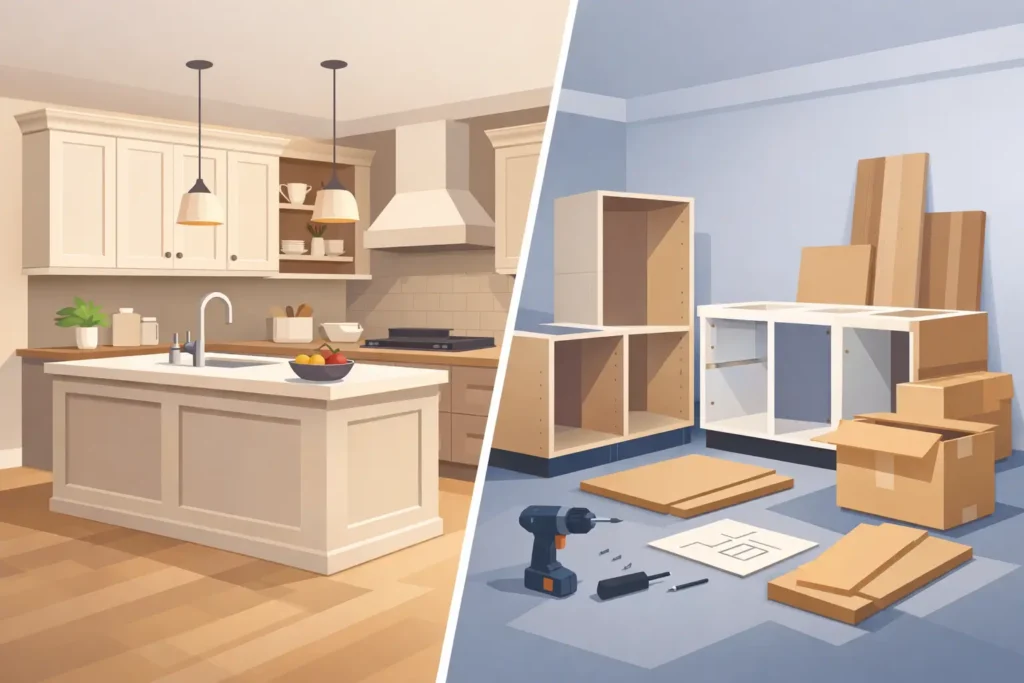
A kitchen can look impressive in a brochure and still disappoint once it meets a real home. Uneven walls, awkward corners, low ceilings, limited storage and busy family life tend to expose the difference very quickly. That is why bespoke kitchens vs flatpack is not simply a style choice – it is a decision about fit, durability, practicality and how well your kitchen will serve you over time.
For some households, flatpack is the sensible answer. For others, bespoke is the better investment because it solves problems that standard units cannot. The right option depends on your home, your budget and how long you expect the kitchen to last.
Bespoke kitchens vs flatpack: the real difference
At the simplest level, flatpack kitchens are made in standard sizes, packed for transport and assembled on site. They are designed to suit a broad market, which helps keep the ticket price lower. If your room is straightforward and your expectations are modest, they can do the job.
A bespoke kitchen is built around your room rather than forced into it. Cabinet sizes, internal storage, finishes and detailing are tailored to the exact dimensions of the space and to the way you use it. That means fewer compromises, especially in older properties, extensions or homes where every millimetre matters.
The key difference is not only what you buy, but how it is planned. With bespoke work, the design starts with your layout, your routines and the character of your property. With flatpack, you usually begin with a set range and try to make the room fit around it.
Cost matters, but so does value
Price is often the first thing people compare, and understandably so. Flatpack usually wins on headline cost. If you are working to a tight budget, renovating a rental property or need a quick improvement without a large outlay, that lower entry point can be attractive.
But headline cost is not the whole story. A lower purchase price can be offset by fillers, oversized voids, extra labour, replacement panels, remedial building work and shorter lifespan. When standard cabinets do not properly suit the room, the finished kitchen can end up looking pieced together rather than properly fitted.
Bespoke kitchens typically cost more upfront because they involve individual design, made-to-measure manufacturing and a more tailored installation process. What you are paying for is accuracy, material quality, stronger construction and a result that makes full use of the room. In many homes, especially where the kitchen is central to day-to-day life, that extra spend translates into better long-term value.
If you plan to move soon, flatpack may feel proportionate. If this is your long-term home, value should be judged over years of use, not just the first invoice.
Fit and finish are where bespoke stands apart
This is usually the point where homeowners see the difference most clearly.
Standard flatpack units come in predetermined widths and heights. If your room does not match those sizes neatly, gaps have to be absorbed somewhere. That often means filler panels, blank spaces or compromises around corners, appliances and tall housings. In some kitchens, that is hardly noticeable. In others, it affects both appearance and storage.
Bespoke kitchens are made to suit the room exactly. Awkward alcoves can become useful cupboards. Ceiling height can be used properly. Islands can be sized to improve movement rather than obstruct it. Features such as larders, pan drawers, breakfast cupboards and integrated bins can be planned around your habits instead of added as afterthoughts.
That level of fit has a visual benefit too. A kitchen that follows the room cleanly tends to feel calmer, more balanced and more expensive, even before you consider the materials.
Quality is more than the door finish
A lot of kitchen comparisons focus on colours, worktops and handles. Those details matter, but the unseen construction matters just as much.
Flatpack cabinets are often made to hit a price point. That can mean thinner boards, lighter-duty fixings and construction methods that rely heavily on on-site assembly. Some ranges are perfectly serviceable, but they are not all built for heavy everyday use over many years.
A bespoke kitchen is generally stronger because it is manufactured with longevity in mind. Cabinet construction, edging, drawer systems, hinges and carcass materials all contribute to how the kitchen performs once it is filled, used and cleaned day after day. Doors need to stay aligned, drawers need to bear weight and units need to cope with heat, moisture and regular wear.
This does not mean every flatpack kitchen is poor quality, or that every bespoke kitchen is automatically excellent. It does mean that with bespoke manufacture, there is far more control over the standard of what goes into your home.
Installation can make or break the result
Even the best-designed kitchen can fall short if the installation is rushed or poorly coordinated.
With flatpack, much depends on who assembles and fits it. If different trades are working separately, delays and miscommunication can creep in. Measurements may need adjusting on site, missing components can slow progress and responsibility is sometimes unclear if something is not right.
A bespoke, full-service approach tends to offer more accountability. Design, manufacturing, project management and installation are joined up, so the process is easier to control from start to finish. That is particularly helpful when a project includes electrical work, plumbing, tiling, flooring or building alterations alongside the kitchen itself.
For homeowners, the practical benefit is peace of mind. There is less chasing, less guesswork and less risk of the finished kitchen feeling like a collection of separate decisions.
When flatpack is the right choice
There are situations where flatpack is entirely reasonable.
If the kitchen is for a utility room, a buy-to-let, a starter renovation or a short-term update before a future extension, spending on full bespoke design may not be necessary. The same applies if the room is a simple box, storage needs are basic and you are comfortable accepting standard sizes and finishes.
Flatpack can also suit confident DIY buyers or trade customers who already have trusted installers and know exactly what they need. In the right setting, with realistic expectations, it can provide a tidy and functional result.
The issue is not that flatpack is wrong. It is that it is often treated as a direct equivalent to bespoke when it is actually a different proposition.
When bespoke is worth it
Bespoke kitchens vs flatpack in period homes and tricky spaces
Older homes across Poole, Bournemouth and the wider Dorset area often come with quirks that standard cabinetry does not handle well. Chimney breasts, sloping floors, out-of-square walls and unusual room proportions can all create wasted space if the kitchen is based on off-the-shelf units.
Bespoke is often the better route when the room is architecturally awkward, when storage is a priority or when the kitchen needs to work hard for family life. It also makes sense when you want a particular finish, a more furniture-led look or continuity with fitted elements elsewhere in the home.
For many clients, the value is not only in appearance. It is in getting a kitchen that functions properly every single day, with thoughtful storage, sensible circulation and a finish that feels considered rather than approximate.
Service matters as much as the product
A kitchen project involves a lot of decisions, and most homeowners do not do it often. That is where guided design and accountable service make a real difference.
Working with an established local specialist such as Hale & Murray gives you access to practical design advice, measured planning, in-house manufacturing and a team that takes ownership of the outcome. That is a very different experience from buying boxed units and hoping every stage lines up smoothly.
For customers who want confidence as well as cabinetry, that support is often part of the reason bespoke feels worthwhile.
How to decide without overcomplicating it
Start with the room. If it is awkward, small, open-plan or central to family life, bespoke deserves serious consideration. Then think about how long you expect the kitchen to serve you. A kitchen you intend to live with for ten or fifteen years needs a different standard from one designed as a short-term refresh.
It also helps to be honest about what will bother you. If filler panels, dead space and standard layouts will annoy you every day, the cheaper option may not feel cheaper for long. If your priority is simply a presentable kitchen at the lowest practical cost, flatpack may be perfectly sensible.
The best decisions usually come from looking beyond the showroom finish and asking harder questions about use, build quality and responsibility for the final result.
A well-planned kitchen should make life easier, not just look good on handover. Choose the option that fits your home properly, suits the way you live and still feels right long after the novelty has worn off.