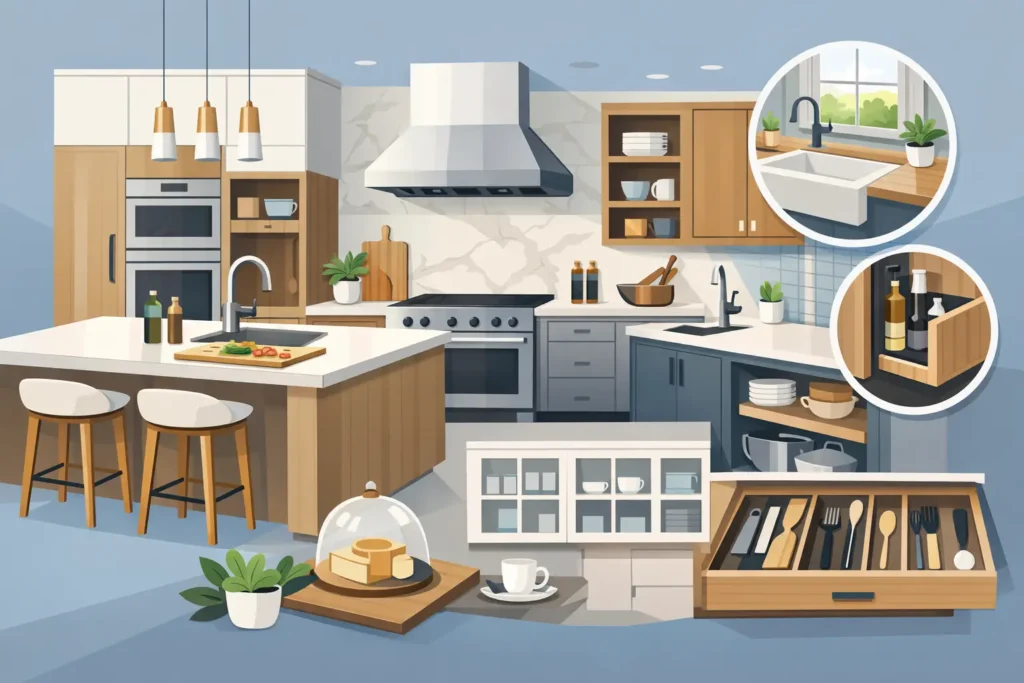
A kitchen usually starts to frustrate people in the same places – the corner cupboard you can never reach properly, the drawers that are never quite deep enough, the awkward gap around an appliance, the island that looks good but gets in the way. That is exactly why the best bespoke kitchen features are rarely the most fashionable ones. They are the details that make the room fit your life, your house and the way you actually use it.
In a genuinely bespoke kitchen, features should not be added for the sake of a showroom display. They should solve problems, improve flow and stand up to daily use. For homeowners investing in long-term quality, that often means looking past standard unit sizes and choosing features that earn their place.
What makes the best bespoke kitchen features worth it?
The real value of bespoke design is precision. When cabinetry is made to suit the room rather than forced into a fixed range, you can make better use of wall lengths, ceiling heights, alcoves and difficult corners. That matters in period properties, extensions, open-plan family spaces and smaller kitchens where every millimetre counts.
It also changes how the kitchen feels to live with. Good bespoke features reduce clutter, make storage easier to reach and support how the household moves through the day. A feature can be beautifully made, but if it does not improve function, it is decoration rather than design.
There is always a balance to strike. Some homeowners want a very clean, pared-back kitchen with hidden storage and integrated appliances. Others need visible, hardworking areas for family cooking, entertaining or bulk storage. The best answer depends on the room, the budget and how much you expect your kitchen to do.
1. Full-height cabinetry built to the room
One of the most useful bespoke choices is full-height cabinetry designed around the exact proportions of the space. In many homes, standard cabinets leave wasted voids at the top or filler panels at the side. Bespoke manufacture allows those gaps to disappear.
That creates a cleaner finish, but the bigger benefit is storage. Full-height larders, housing units and utility cupboards can hold far more than a conventional layout, especially in kitchens where floor space is limited. It is particularly effective in Dorset homes with uneven walls, chimney breasts or extensions where off-the-shelf sizing often looks like a compromise.
The trade-off is that very tall cabinetry needs careful planning. If every run is floor to ceiling, the room can feel heavy. A good design will usually mix tall storage with open worktop areas to keep the kitchen comfortable and balanced.
2. A proper pantry or larder cupboard
A well-designed pantry remains one of the best bespoke kitchen features because it solves a common problem properly. Dry goods, small appliances, serving pieces and everyday food shopping all need a home, and most standard kitchens never quite provide enough organised space.
A bespoke pantry can be fitted out around your habits. Some households benefit from internal drawers and spice racks. Others need shelves sized for cereal boxes, baking equipment or larger food shops. If you prefer worktops free of clutter, a breakfast station with pocket doors can also make sense, keeping the kettle, toaster and coffee machine tucked away but ready to use.
This is where bespoke work shows its value. The internal layout matters just as much as the door front, and custom storage is far more effective when it reflects what you actually buy and use.
3. Deep drawers instead of too many cupboards
Base cupboards still have their place, but in many kitchens deep drawers are simply easier. Pots, pans, crockery and food containers are more visible and more accessible in a drawer than at the back of a shelf. You do not have to kneel on the floor and reach into a dark corner to find what you need.
In a bespoke kitchen, drawer widths and depths can be chosen to suit the items being stored rather than forcing everything into standard sizes. Wider pan drawers beneath a hob, for example, can make daily cooking much easier. Shallower internal drawers inside a larder or island can also bring order to the things that usually end up loose and untidy.
The point is not to replace every cupboard with drawers. It is to use them where they improve access most.
4. An island that is shaped by workflow
Kitchen islands are often treated as a must-have, but not every room needs one. In some spaces, a peninsula or a better run of perimeter cabinetry will work harder. When an island is the right choice, though, bespoke design allows it to become one of the most effective features in the room.
The key is function. An island can provide preparation space, informal seating, extra storage, bin housing or a place to gather without interrupting the cook. It can also help define an open-plan layout. The dimensions matter a great deal. Too large, and it blocks movement. Too small, and it becomes decorative rather than useful.
This is where a made-to-measure approach earns its keep. The best island is not the one that fills the room. It is the one that improves the room.
5. Integrated bins and recycling storage
It is not the glamorous part of kitchen design, but waste storage has a direct impact on how tidy and practical the space feels. Integrated bin and recycling systems keep everything concealed, organised and close to the preparation area.
Bespoke cabinetry means these compartments can be positioned where they make most sense. Near the sink and prep zone is often ideal, but every household works differently. Some families need larger recycling capacity. Others want food waste separated neatly for garden composting.
This kind of detail often makes a bigger difference than people expect. It reduces visible clutter and helps the kitchen stay calmer during busy mornings and evening cooking.
6. Appliance housing that looks intentional
Appliances can easily make a kitchen feel pieced together if they are not planned well. Bespoke housing solves that by creating cabinetry around ovens, refrigeration and smaller built-in elements with a more considered finish.
That does not always mean hiding everything. Sometimes a statement range cooker deserves to be seen. In other kitchens, integrated refrigeration or a concealed dishwasher helps maintain a quieter visual line. The best approach depends on the style of the room and how much emphasis you want on the practical elements.
What matters is proportion. Custom housing units can align appliances neatly with surrounding cabinetry, improve ergonomics and avoid the filler strips and awkward gaps that often come with standard ranges.
7. Clever corner solutions
Corners are where many kitchens lose usable space. A bespoke layout gives you more options, whether that means designing out the problem altogether or fitting internal storage that makes the area easier to use.
Le Mans pull-outs, corner drawers and diagonal storage can all work, but they are not automatically the right answer. In some kitchens, a blind corner with stronger storage elsewhere is simpler and better value. In others, especially compact rooms, a well-planned corner mechanism is worth having.
This is a good example of where honest design advice matters. Not every available gadget improves a kitchen. The best bespoke kitchen features are the ones chosen with restraint.
8. Bespoke lighting built into cabinetry
Lighting is often left too late, yet it has a major effect on both atmosphere and usability. Cabinet-integrated lighting under wall units, within glazed cabinets or inside larders can make the kitchen easier to work in and more welcoming in the evening.
Task lighting is the most practical place to start. Worktops need clear, even light for preparation. Beyond that, internal cabinet lighting can add convenience, while plinth or feature lighting can soften an open-plan room after dark.
It depends on the overall scheme. Too many lighting effects can feel busy. Used carefully, though, built-in lighting gives a bespoke kitchen a more refined and considered finish.
9. A seating area that earns its footprint
Bespoke seating can be a strong addition if the kitchen is used as a social space. That might mean banquette seating, an island overhang designed for comfortable stools, or a fitted breakfast nook that makes use of an awkward corner.
The important thing is comfort and clearance. Seating has to work with circulation, not fight against it. There is little value in squeezing in stools that no one can sit on properly, or a bench that blocks access to storage.
When planned well, a fitted seating area makes the kitchen more useful throughout the day, especially for family households, informal meals and catching up over coffee.
10. Worktops and details chosen for daily use
The final feature is less about one item and more about the finishing choices that shape daily life. Worktop depth, edge profiles, splashbacks, handles or handleless rails, charging points and even drawer organisers all affect how the kitchen performs.
This is where experience helps. A beautiful material still needs to suit the level of maintenance you are happy with. A handleless kitchen can look crisp and contemporary, but some clients prefer the feel and practicality of a well-made handle. Timber adds warmth, but around heavy-use zones it may need more care than stone or compact laminate.
These decisions are rarely about right or wrong. They are about matching the kitchen to the people using it.
Choosing the best bespoke kitchen features for your home
The strongest kitchens are not built from a checklist. They come from understanding the property, the household and the level of finish you want to live with for years. For some clients, that means a classic painted kitchen with a beautifully fitted pantry and generous island. For others, it means a pared-back contemporary room with hidden storage, clean lines and integrated appliances.
At Hale & Murray, that is why design starts with the space and the brief rather than a stock range. Features should feel purposeful, well made and properly resolved from the start.
If you are planning a new kitchen, focus first on the frustrations you want to remove and the routines you want to improve. The right bespoke features will follow from there, and those are usually the ones you appreciate every single day.