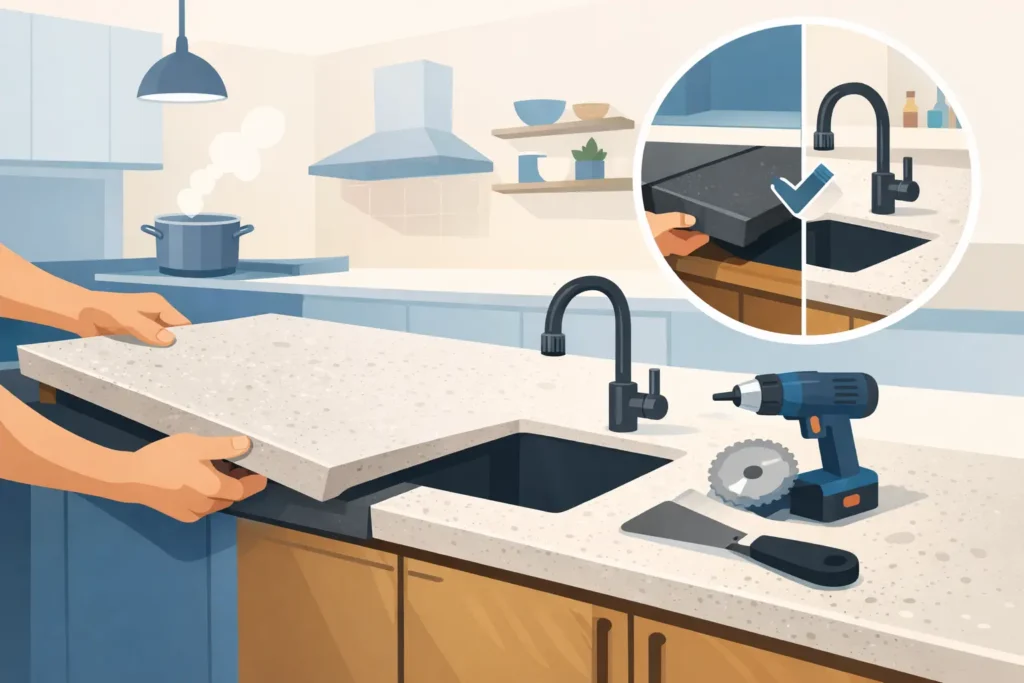
A tired worktop has a way of making the whole kitchen feel past its best. Chips by the sink, scorch marks near the hob, swollen edges around joints – these are often the details that prompt the question: can you replace kitchen worktops without taking out everything else? In many cases, yes, you can. But whether it is straightforward, cost-effective or the right long-term choice depends on the condition of the units underneath, the layout of the room and the finish you want to achieve.
For many homeowners, replacing the worktops is a practical middle ground. It can refresh the look of the kitchen, improve day-to-day durability and avoid the disruption of a full refit. That said, worktops do not sit in isolation. They connect to cabinets, walls, appliances, plumbing and often the upstands, splashbacks and sink cut-outs too. A good result depends on treating it as a proper fitted project, not just a simple surface swap.
Can you replace kitchen worktops on existing cabinets?
In principle, yes. Existing cabinets can often take new worktops if they are level, structurally sound and still worth keeping. If the carcases are solid and the kitchen layout is staying the same, replacing the worktops can be a very sensible upgrade.
The main limitation is not usually the top itself. It is the condition and accuracy of what sits below it. Older units may have moved slightly over time, walls may not be straight, and previous installations can hide all sorts of compromises. If cabinets are twisted, swollen from water damage or poorly fixed, fitting new worktops over them may store up problems rather than solve them.
This is especially true with heavier materials such as quartz, granite or ceramic. These demand proper support and accurate templating. Even laminate and timber need a stable, level base if you want neat joints and a finish that lasts.
When replacement makes sense
Worktop replacement tends to work well when the kitchen is basically sound but looks dated or has localised wear. If the cabinet doors are in decent condition, the storage still works for your household and the room layout suits how you live, changing the tops can make a visible difference without the upheaval of starting again.
It is also a useful option if you want to upgrade performance. Many people move from older laminate to a material that is more heat-resistant, easier to maintain or better suited to a busier family kitchen. In some homes, replacing the worktops alongside new doors, panels or splashbacks gives the room a far more complete refresh than people expect.
There is also the question of property value and timing. If you are not ready for a full kitchen investment now, but the current worktops are letting the room down, replacement can bridge that gap sensibly.
When a new kitchen may be the better route
There are times when replacing worktops is possible but not advisable. If units are worn out, drawer runners are failing, hinges are loose and the layout no longer works, new tops can end up looking like an expensive patch on a kitchen that still feels old.
The same applies if major plumbing or electrical changes are needed. Once sinks, hobs and appliances are being moved, the project can quickly become more involved. At that point, it is worth asking whether the money would be better invested in a full redesign that improves storage, flow and long-term value.
A professional survey often brings clarity here. What seems like a simple swap from the outside can reveal uneven cabinets, hidden leaks or awkward service routes. Better to know that before committing to a material.
Choosing the right material for replacement worktops
The best material is not just about appearance. It needs to suit the existing kitchen, your budget and how much adaptation the room will need.
Laminate remains a practical choice for many homes. It offers a wide range of finishes, keeps costs more controlled and is generally easier to fit in properties where walls and angles are less forgiving. Modern laminates can look far better than many people expect, particularly when paired with updated doors or panels.
Solid timber brings warmth and character, but it does require care. Around sinks and joints, regular maintenance matters. It can be a lovely option in the right setting, though not every household wants that level of upkeep.
Quartz and granite are popular for good reason. They feel substantial, wear well and can transform the look of a kitchen. They do, however, rely on accurate measuring, careful handling and suitable support from the cabinets below. Ceramic and sintered stone surfaces can also be excellent, especially where heat resistance is important, but they are not automatically the right answer for every budget or layout.
The point is not to choose the most expensive top. It is to choose the one that suits the kitchen you have and the way you use it.
What is involved in replacing kitchen worktops?
Replacing kitchen worktops usually starts with a detailed site survey. Measurements need to be exact, but so does the assessment of levels, wall condition, access and the position of appliances and services.
The old worktops then need to be removed carefully. This can affect sinks, taps, hobs, silicone seals, upstands and tiling. In some kitchens, tiles sit down onto the existing top, which means removal can damage the lower row. That is not a reason to avoid the project, but it does need to be factored in from the start.
If the new worktop is a different thickness or material, small adjustments may be needed to plumbing, hob clearances, end panels or decorative trims. Stone products usually involve a template visit after preparation, followed by fabrication and then fitting. Laminate can sometimes be completed more quickly, but it still needs proper finishing if the result is going to look right.
This is why worktop replacement often works best with a company that can manage the whole job. Joinery, plumbing, templating and installation all need to line up properly.
Common issues that affect cost and complexity
The headline price of a worktop tells only part of the story. The real cost depends on the shape of the kitchen, the number of cut-outs, joint positions, access to the property and what else has to come off and go back on.
Undermounted sinks, waterfall ends, breakfast bars and large islands add complexity. So do uneven walls and older houses where not much is square. If you are replacing a top around existing appliances, dimensions have to be checked carefully. A new worktop can expose small fitting inaccuracies that the old one happened to conceal.
There is also the finish around the edges of the project. You may decide to keep the existing splashback and tiles, or you may find that new upstands and a few finishing touches are what make the replacement feel complete.
Can you replace kitchen worktops yourself?
Some homeowners can, particularly with straightforward laminate runs and a good level of practical skill. But there is a difference between making it fit and making it look properly fitted.
Mitre joints, cut-outs, scribing to uneven walls and reconnecting sinks or hobs all carry risk. One poor cut can ruin a length of worktop. With stone, quartz or ceramic, DIY is rarely realistic because templating, fabrication and safe installation require specialist equipment and experience.
For supply-only customers or capable tradespeople, replacement can still be very manageable with the right preparation. The key is being honest about the standard you want and the margin for error you can afford.
Getting the best result from a replacement project
If you are considering new worktops, the best starting point is not a brochure or colour sample. It is a proper look at the kitchen as it stands. Are the cabinets worth keeping? Is the layout still right? Will the finish you have in mind work with the age and style of the rest of the room?
A measured, honest approach saves money and disappointment. In some homes, replacing the worktops is exactly the right decision and gives the kitchen several more years of smart, reliable use. In others, a broader update will make more sense.
At Hale & Murray, this is often where experience matters most – not in pushing one answer, but in helping homeowners understand what is practical, what is worthwhile and what will look right when the job is complete.
If your kitchen still works but no longer feels as good as it should, a new worktop may be the change that brings it back to life without turning the whole house upside down.