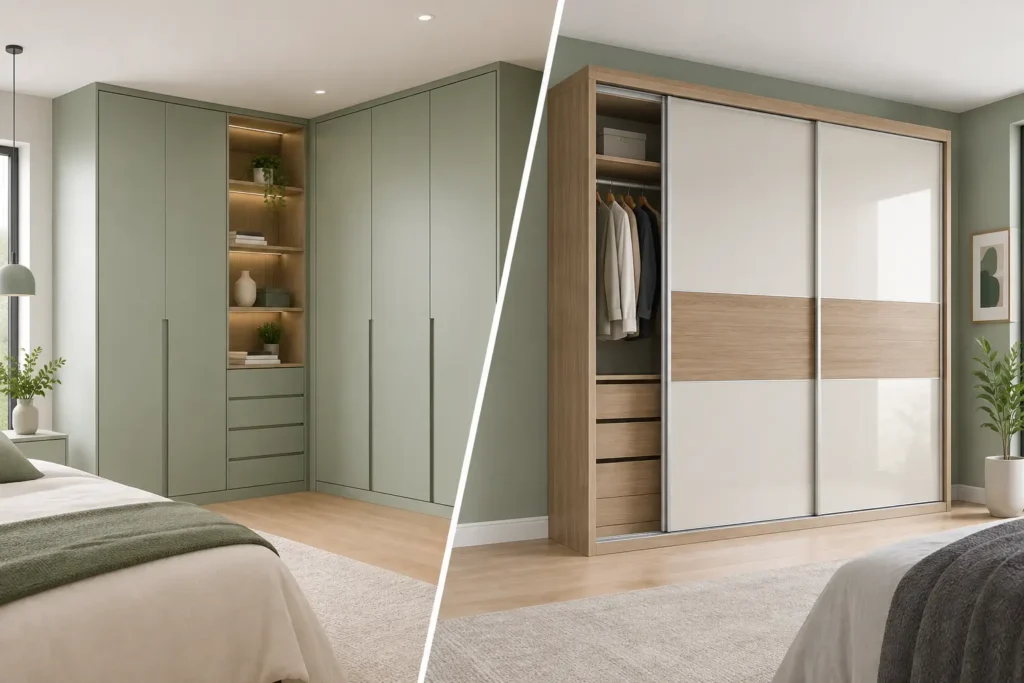
A bedroom can look generous on a plan, then feel surprisingly tight once a bed, bedside tables and an opening wardrobe door are in place. That is why the question of a fitted wardrobe or sliding wardrobe deserves more than a quick choice based on appearance. The best option is the one that gives you useful storage, comfortable movement around the room and a finish that belongs in your home.
There is one point worth clearing up first: fitted and sliding are not always opposite choices. A wardrobe can be fully fitted to your room and have sliding doors. Equally, a fitted wardrobe can use hinged doors. The practical decision is usually between a bespoke, wall-to-wall fitted solution and the particular door style that suits the space.
Fitted wardrobe or sliding wardrobe: understand the difference
A fitted wardrobe is made for the room rather than selected from standard sizes. It can run from wall to wall, floor to ceiling, around a chimney breast, beneath a sloping ceiling or into an awkward alcove. Its doors may be hinged, sliding, folding or even a combination of styles.
A sliding wardrobe refers specifically to how the doors operate. Rather than opening out into the room, panels run along a track and pass in front of one another. Sliding doors are often used on fitted wardrobes, but they can also be supplied as part of a more standard wardrobe system.
For most homes, the useful comparison is not simply fitted versus sliding. It is whether your room needs the made-to-measure storage and tailored layout of fitted furniture, and whether sliding or hinged doors will make day-to-day use easier.
When a fitted wardrobe is the better investment
A fitted wardrobe is particularly valuable when the room has dimensions that standard furniture cannot use well. Older Dorset homes often have alcoves, uneven walls, chimney breasts and ceiling slopes. Newer properties can bring their own challenge: compact bedrooms where every centimetre matters.
With furniture designed around those conditions, the storage can be planned for the people using it. A couple may need separate hanging sections, shallow drawers for accessories and a high shelf for spare bedding. A child’s room may benefit from lower rails and adaptable shelving. In a principal bedroom, an integrated dressing area, bedside units or a discreet television recess may be more useful than a simple run of cupboards.
The visual result matters too. A well-designed fitted wardrobe avoids the dust-catching gaps above and beside freestanding furniture. Matching panels and carefully chosen handles can make the room feel calmer and more considered, particularly where storage occupies a whole wall.
The trade-off is that bespoke fitted furniture is a long-term decision. It should be designed with the room’s future use in mind, not just today’s pile of clothes. Good internal planning and durable materials are more important than adding every possible feature.
Make the inside work as hard as the outside
Doors create the first impression, but the interior determines whether the wardrobe remains organised six months later. Before choosing finishes, take stock of what genuinely needs to be stored: long coats, shirts, knitwear, shoes, suitcases, laundry and bedding all need different depths and heights.
A practical wardrobe usually combines full-length hanging, double hanging for shorter garments, adjustable shelving and drawers. Deep shelves may seem generous, but they can turn into forgotten piles at the back. Drawers are often better for smaller items, while upper cupboards are ideal for seasonal storage that does not need daily access.
A home design visit is particularly useful here. It allows the designer to measure accurately, check for radiators, sockets and pipework, and talk through how you use the room rather than relying on assumptions from a showroom plan.
When sliding doors make most sense
Sliding doors come into their own where there is limited clearance in front of the wardrobe. A hinged door needs enough room to swing open comfortably, without colliding with a bed frame, chest of drawers or bedroom door. Sliding panels stay within the wardrobe footprint, which can make a narrow room easier to move around.
They also suit a contemporary, uncluttered look. Large panels can create a calm run of furniture with minimal visible detail. Depending on the design, sliding doors can use painted finishes, wood effects, coloured glass or mirrors. Mirrored panels can be helpful in smaller bedrooms because they reflect light and remove the need for a separate full-length mirror.
There are sensible compromises, however. With a sliding wardrobe, only part of the interior is open at one time. That is rarely a problem for everyday storage, but it is less convenient when two people are getting ready together or when you want a complete view of the contents. The track system also needs to be well made and properly installed so doors run smoothly and remain aligned.
For very wide wardrobes, sliding doors can be an excellent answer. For a compact two-door wardrobe, hinged doors may offer simpler access and more choice in door detailing.
Why hinged doors should not be overlooked
Hinged doors are often dismissed as the traditional option, but they are far from old-fashioned. They allow the full wardrobe interior to be open at once, making them practical for dressing, tidying and seeing exactly what is available. They can also accommodate internal drawers, pull-out accessories and lighting without the overlap considerations of sliding panels.
From a design perspective, hinged doors offer broad flexibility. Shaker-style doors, framed designs, painted finishes and traditional handles can sit comfortably in period properties, while a flat slab door with a discreet handle works well in a more modern bedroom.
The key question is clearance. If there is a clear route around the bed and enough space for doors to open without becoming an obstacle, hinged doors may be the most convenient choice. If the room feels cramped before the doors are even open, sliding doors deserve serious consideration.
Measure more than the available wall
It is tempting to begin with the largest wall in the bedroom. In reality, the space in front of that wall is just as important. Consider the bed position, drawers, window opening, radiator access and how the bedroom door swings. A wardrobe that technically fits can still make the room frustrating to use.
Ceiling height is another opportunity. Full-height fitted wardrobes offer valuable storage for luggage, duvets and items used only occasionally. They can also make a low or awkward ceiling line feel intentional when the cabinetry is designed to follow it.
Do not assume every wall is square or every floor is level. Made-to-measure furniture is designed and scribed to accommodate those details, producing a neater result than trying to fill gaps with trims after installation. This is one of the strongest reasons to choose a local specialist with the ability to manufacture and fit the furniture as one accountable service.
Choose materials and finishes for real life
A wardrobe should suit the way your household lives, not only a photograph. Matte painted finishes can look elegant and restrained, while wood-grain textures add warmth. Gloss and mirrored doors bounce light around a darker room, although they may show fingerprints more readily. A handleless look feels clean, but handles can be easier to use and can give the furniture more character.
Consider how the wardrobe relates to the rest of the bedroom. Matching bedside cabinets or a dressing table can make the room feel settled, but exact matching is not the only answer. A soft contrast in colour or texture can give a large fitted run less visual weight.
It is also worth asking about replacement doors and future alterations. Tastes change, children grow up and a bedroom may become a home office or guest room. A well-planned bespoke installation can be updated more easily when the original manufacturer understands the construction and can advise on compatible options.
A practical route to the right decision
Start with how you want the bedroom to feel when you use it on an ordinary weekday morning. If limited floor space is the main problem, a fitted wardrobe with sliding doors may give you the clearest route around the room. If access to every section of storage matters most, fitted hinged doors may be the stronger choice.
Then focus on the interior. Allocate space based on your actual wardrobe, not an idealised version of it. Finally, choose a style that will still feel right when the bedding, paint colour and smaller furnishings change.
At Hale & Murray, wardrobes are designed around the room, made in-house and installed with the same care given to the planning stage. A free design consultation offers the chance to compare door styles, finishes and storage layouts properly before committing.
The most satisfying bedroom storage does not call attention to itself every day. It simply gives everything a place, leaves room to move and makes the start and end of each day feel that little bit easier.