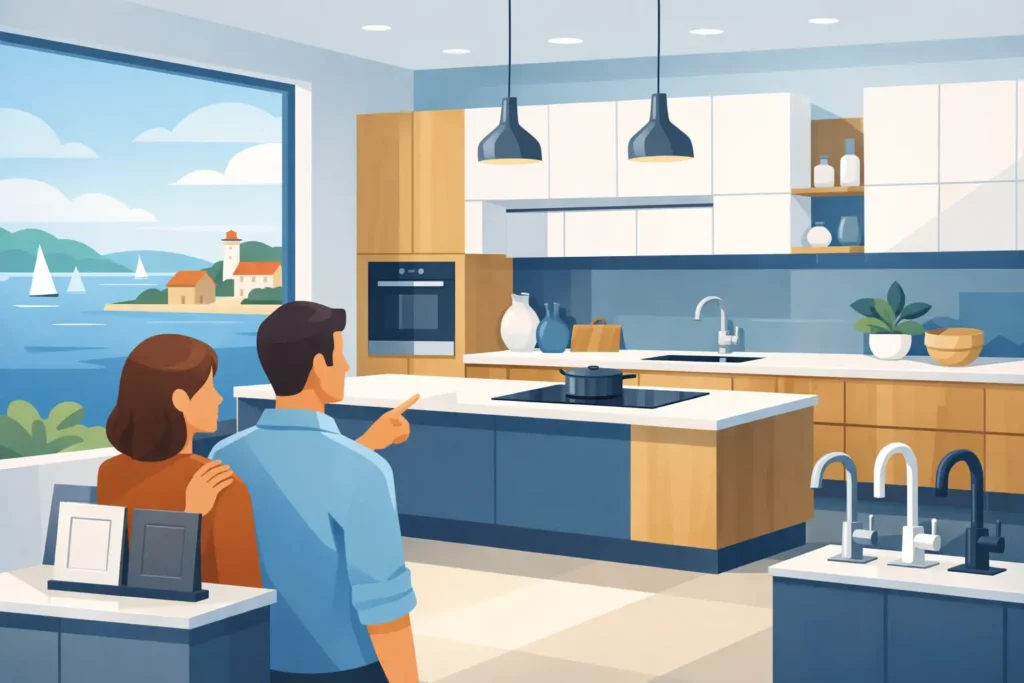
If you are planning a new kitchen, a good kitchen showroom Poole can save you weeks of second-guessing. Seeing doors, worktops, storage solutions and layout ideas in person tells you far more than a screen ever will. You get a proper sense of scale, finish and build quality, and that matters when you are investing in a room used every day.
A showroom visit should do more than give you inspiration. It should help you make better decisions. The right one will show you how a kitchen can be shaped around your home, your routines and the way you actually live, rather than steering you towards a standard range that almost fits.
Why a kitchen showroom in Poole still matters
There is no shortage of online inspiration. You can save hundreds of images, compare colours and follow every new trend. The problem is that kitchens are practical spaces, not just visual ones. A handle that looks smart in a photo may feel awkward in daily use. A painted finish may suit one light level and look entirely different in another. A layout that works in a large open-plan extension may be frustrating in a period property with tighter dimensions.
That is where a showroom earns its place. You can open drawers, test mechanisms, compare cabinet styles and see how different materials sit together. You also get the chance to talk through what will and will not work in your room. For many homeowners in Poole and the surrounding Dorset area, that conversation is where the project starts to feel real.
There is also a practical difference between a showroom that simply displays products and one backed by a team that designs, manufactures and installs. In the first case, you may leave with ideas. In the second, you leave with answers.
What to expect from a quality kitchen showroom Poole
A well-run showroom should feel helpful, not pressured. You should be able to browse at your own pace, ask questions and discuss options in plain English. Good advice is rarely about pushing the most expensive choice. It is about understanding how you use the space and guiding you towards the right balance of layout, storage, materials and budget.
That usually starts with the basics. How many people cook at once? Do you need space for children to do homework at the island? Are you short on pantry storage? Do you want a kitchen that blends into an open-plan living area, or one that makes a stronger design statement? These are the details that shape a better result.
You should also expect to see a mix of styles and finishes rather than one narrow look. Traditional in-frame cabinetry, modern handleless designs, timber effects, painted doors, stone worktops, breakfast cupboards, pull-out larders and clever corner storage all help you weigh up what suits your home. The more complete the display, the easier it is to compare options properly.
Bespoke versus off-the-shelf – why the difference matters
Not every home suits standard units. In fact, many do not. Older properties, awkward corners, sloping ceilings and unusual room proportions often expose the limits of off-the-shelf kitchen ranges. Fillers become wider, storage becomes less efficient and the finished room can look like a compromise.
Bespoke manufacture changes that. Cabinets can be made to suit the room rather than forcing the room to suit the cabinets. That can mean better use of space, cleaner lines and a more considered finish. It also opens up more flexibility in height, width, depth and internal storage.
This is especially valuable if you have a clear idea of how you want the kitchen to work. Perhaps you need deeper drawers for pans, a more practical utility run, or integrated storage that keeps surfaces clearer. A made-to-measure approach gives far more control.
There is a cost difference, of course, and bespoke is not always necessary in every part of the room. For some projects, a blend of tailored design and selective upgrades is the smarter route. A good showroom team will talk honestly about that rather than treating every job the same.
Why in-house manufacturing gives you more control
One of the strongest signs of a dependable showroom is what sits behind it. If the business designs in-house and also makes furniture in its own workshop, there is a clearer line between what is promised and what is delivered.
That matters for accuracy, accountability and lead times. Design changes can be handled more efficiently. Unusual sizes are less of a headache. Replacement doors, worktops and matching additions are easier to arrange later on. If a customer wants supply only rather than a full installation, that can often be accommodated with more flexibility too.
For homeowners, the practical benefit is peace of mind. You are not dealing with a chain of separate suppliers trying to interpret one another’s plans. You are dealing with one team that can take ownership from first discussion through to fitting.
The questions worth asking in the showroom
A showroom visit is your chance to look past the polished displays and understand how the project will actually run. Ask who carries out the survey, who produces the kitchen, who manages the installation and what happens if building work, plumbing or tiling are needed alongside the cabinetry.
You should also ask about timescales. Bespoke work is worth waiting for, but you still need a realistic programme. Ask how long the design stage usually takes, when manufacturing starts, and how installation is coordinated. If the kitchen is part of a wider renovation, this becomes even more important.
Accreditations and trading history matter as well. A long-established local company with recognised industry membership and trusted review credentials offers a different level of reassurance from a newer operation with a smart brochure and limited track record. When you are spending serious money on your home, accountability counts.
Good design is about daily life, not just appearance
A kitchen can be beautifully finished and still get the basics wrong. Too little worktop near the hob, awkward fridge placement, poor bin storage or not enough sockets will soon be noticed. Strong showroom design advice should therefore go beyond colour choices and focus on how the room performs.
That includes workflow, lighting, storage and movement. The best layouts reduce friction. There is enough room to unload shopping, prepare meals and move around comfortably. Frequently used items are kept within easy reach. Seating, if included, feels practical rather than squeezed in for effect.
This is where a free design consultation and home visit can make a real difference. What works in the showroom has to be translated into your property, with its own dimensions, access points, windows and structural limits. A designer who takes the time to understand the space will nearly always produce a better outcome.
Local knowledge has real value
Choosing a local specialist is not simply a matter of convenience. A company working regularly across Poole, Bournemouth and the wider Dorset area is likely to understand the mix of properties common here, from modern developments to older family homes and downsizing projects near the coast.
That experience helps when planning around uneven walls, compact footprints or open-plan reconfigurations. It also tends to improve communication. If you want to revisit the showroom, review samples again or discuss a final detail face to face, that is far easier with a nearby team.
Established local firms also have more to lose by getting things wrong. Their reputation is built over decades, not a single sales quarter. For customers, that usually means a more careful and accountable service.
Looking beyond the display kitchen
The nicest display in the room is not always the best indicator of service. What matters just as much is how the business handles detail. Are you given clear answers? Are trade-offs explained honestly? Are you encouraged to consider how materials will wear over time, not just how they look on day one?
For example, a painted timber finish can look exceptional, but households with young children may prefer something more forgiving in heavy-use areas. A statement worktop may be beautiful, yet require more maintenance than some buyers expect. True expertise means helping you weigh those decisions properly.
That is why many homeowners prefer a showroom backed by genuine craftsmanship and project management, not just sales. Hale & Murray has built its reputation on that combination – bespoke design, in-house manufacture and an accountable service shaped around the customer from start to finish.
A kitchen should feel right long after the showroom visit is over. If you choose carefully, that first conversation in Poole can lead to a room that works harder, lasts longer and feels properly made for your home.