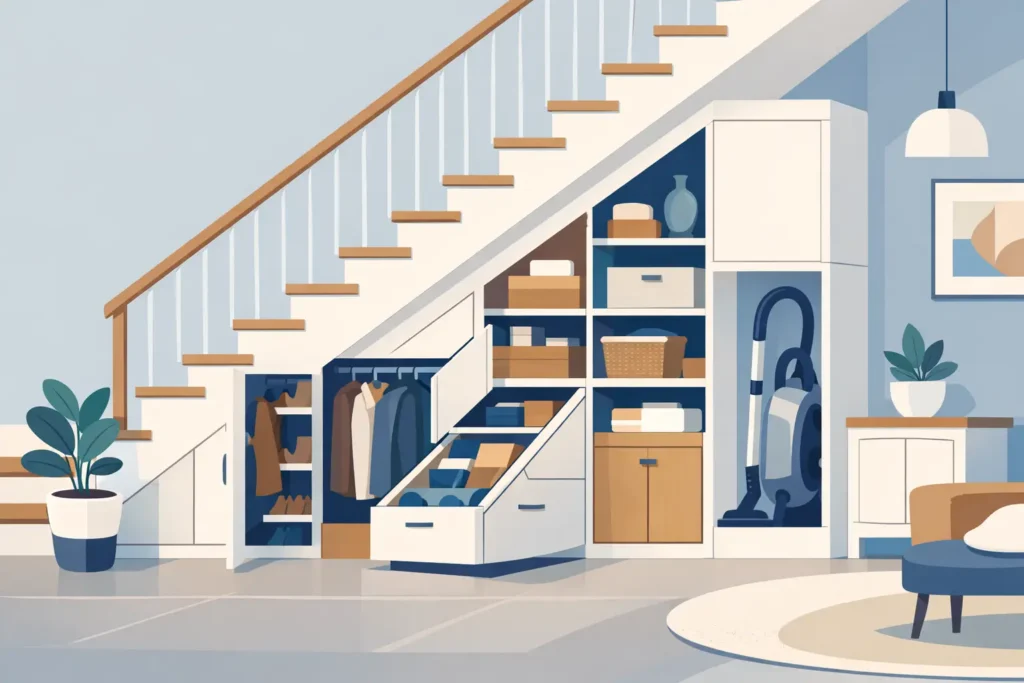
That awkward space beneath the staircase has a habit of collecting everything you do not quite know where to put – coats, shoes, cleaning items, bags, paperwork, even the hoover. Well-designed under stairs fitted storage changes that completely. Instead of a dark cupboard or a cluttered corner, you gain storage that is built around your home, your routine and the exact shape of the space.
For many homes, this is one of the most overlooked opportunities for fitted furniture. Hallways are often short on usable storage, and open-plan ground floors can make everyday clutter feel even more visible. The space under the stairs may not look straightforward, but that is exactly why bespoke design matters.
Why under stairs fitted storage makes such a difference
The biggest advantage is not simply that you get more storage. It is that you get the right kind of storage in a place that is usually difficult to use well. Off-the-shelf units rarely suit the changing height, depth and angles beneath a staircase. They tend to waste space at the back, leave awkward gaps, or make access harder than it needs to be.
With fitted cabinetry, every section can be planned properly. Full-depth drawers can make use of the deepest part. Shelving can be set where head height allows. Hanging space can be added for coats if the entrance hall needs to work harder. Even shallow sections can become useful for shoes, pet accessories or household essentials.
There is also the visual difference. When storage is made to measure, it feels part of the house rather than an afterthought. In a hallway, that can help the whole ground floor look calmer and more considered.
What can be included under the stairs?
This depends on the shape of your staircase, the available footprint and how you live day to day. Some households need a smart boot-room style arrangement by the front door. Others want concealed general storage that keeps the hallway clear.
A common approach is to combine different elements within one run of cabinetry. Drawers are ideal for shoes, school bags and smaller items that would otherwise end up scattered around. Cupboards can hide larger belongings such as the vacuum cleaner, ironing board or cleaning supplies. Open niches can work well for baskets or decorative pieces, although they do require more discipline to keep tidy.
In some homes, under stairs fitted storage can also include a seating area with storage below, which is especially useful in family homes where putting shoes on at the door is part of the daily routine. In others, it may make sense to incorporate a small desk area, a dog bed, a wine store or shelving for books. The best answer is rarely the one that looks good in a photograph. It is the one that solves the storage pressure in your own home.
The design details that matter most
Good fitted furniture should make life easier, not just look neat on installation day. That is why the internal layout matters as much as the external finish.
Think first about access. A deep cupboard sounds useful, but if items disappear into the back and never come out again, it is not doing its job. Pull-out drawers often make better use of the lowest and deepest parts of the staircase because they bring the contents out to you. That can be especially helpful in a busy hallway where quick access matters.
Door style matters too. In a narrow entrance hall, large hinged doors can be inconvenient because they need room to open. In some cases, smaller doors or more drawer-based storage will work better. Handle choice, soft-close mechanisms and durable finishes are not small details either. These are high-use areas, and the furniture needs to stand up to daily wear.
Lighting can also be worth considering. If the area under the stairs is naturally dark, subtle internal lighting or adjacent hallway lighting can make the whole space more practical and welcoming.
Style should match the rest of the home
One of the benefits of bespoke storage is that it does not need to look purely functional. In fact, the most successful projects usually tie in with the wider interior so the joinery feels intentional.
In a period property, that might mean shaker-style fronts, a painted finish and traditional detailing that sits comfortably with the character of the house. In a newer home, cleaner lines and simpler slab doors may be more appropriate. Colour also plays a part. Lighter tones can help a hallway feel larger and brighter, while darker painted finishes can look smart and grounded if the space has enough natural light.
It is worth being realistic here. Pale finishes can show marks more easily in family hallways, particularly around handles and lower doors. Darker shades can hide some scuffs, but they may make a small area feel heavier. There is no universal right answer. It depends on the home, the light and how the space is used.
Why bespoke usually outperforms off-the-shelf options
Under-stair spaces are rarely square, level or predictable. Older homes can be particularly challenging, with uneven walls, slight variations in angles and features such as skirting, meters or pipework to work around. This is where true made-to-measure furniture earns its place.
A bespoke solution can be surveyed properly, designed around obstacles and built to maximise every usable section. It can also be finished to a much higher standard than piecing together generic units and filler panels. That matters if the staircase sits in a prominent part of the home.
There is a cost difference, of course, and it is sensible to acknowledge that. Bespoke fitted furniture is an investment, not the cheapest route to storage. But for homeowners planning to stay put, the return is often felt every day in the way the home functions. Better organisation, better use of space and a cleaner finish tend to justify the decision far more than a short-term workaround.
Planning under stairs fitted storage properly
The best projects start with honest questions. What is currently stored there, and what should be stored there? Is this mainly hallway storage, household storage or a mixture of both? Do you want everything hidden away, or would some open access be useful?
Measurements are only part of the process. You also need to think about movement around the space, especially if the staircase is close to the front door or part of a main route through the house. Storage that is technically generous but awkward to use will quickly become frustrating.
This is also the stage to think about future needs. A young family may want room for school bags, prams and coats now, while a downsizer may prefer easier access for household essentials without lots of bending. Good design should reflect how you live now while still making sense in a few years’ time.
For homeowners in Poole, Bournemouth and the surrounding Dorset area, working with a company that can design, manufacture and install as one service tends to make the process much more straightforward. With Hale & Murray, that means ideas can be discussed in practical terms from the outset, then made to measure in our own workshop for a finish that suits the house properly.
Common mistakes to avoid
The first is trying to copy someone else’s layout without considering your own routine. A stylish bank of drawers may look impressive, but if what you really need is hanging space for coats and room for the vacuum cleaner, it will not be the right answer.
The second is underestimating internal storage sizes. Shoes, backpacks, cleaning equipment and pet items all take up more room than people expect. It is better to plan generously than create cabinetry that is neat but not genuinely useful.
The third is ignoring the surrounding hallway. Under-stair furniture should improve the space around it, not make it feel tighter. Proportions, door swings and circulation all need attention.
A worthwhile upgrade for everyday living
The value of fitted storage under the stairs is not only in the cabinetry itself. It is in what it gives back to the rest of the home. Hallways feel calmer. Everyday items have a place. The house works with less effort.
When that storage is designed carefully and built properly, even an awkward area can become one of the most useful parts of the ground floor. If you are looking at the space beneath your staircase and seeing clutter, compromise or wasted potential, that is usually a sign the space could do far more for you.