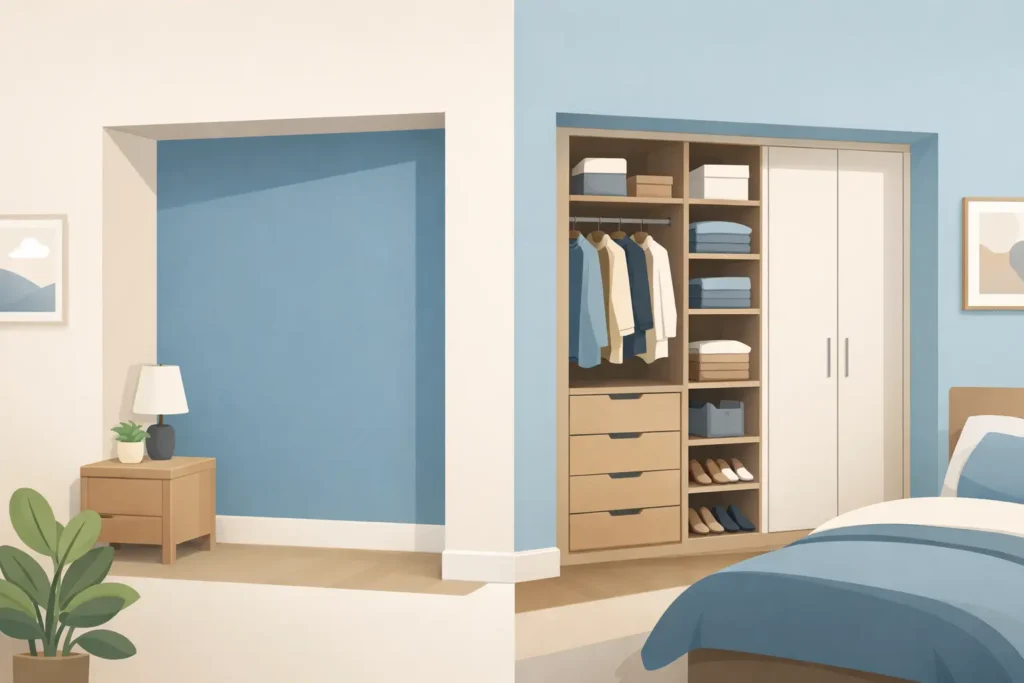
If you have an alcove in a bedroom, you already know the problem. It is rarely quite square, often interrupted by skirting, coving or pipework, and never seems to suit standard furniture. That is exactly why homeowners ask whether can fitted wardrobes fit alcoves is more than a simple yes or no. In most cases, they can – and when they are properly designed, alcoves often make some of the best wardrobe spaces in the room.
The key is not forcing a standard carcass into an uneven recess. A good alcove wardrobe is measured around the room as it really is, then built to suit the walls, ceiling height and the way you need the storage to work day to day.
Why alcoves suit fitted wardrobes so well
Alcoves are awkward for freestanding furniture because off-the-shelf wardrobes are made to fixed widths, fixed depths and square assumptions. Older properties in particular tend to have chimneys, breast projections and wall lines that are anything but uniform. The result is usually wasted space at the sides, gaps at the top, and a room that looks less settled than it should.
Fitted wardrobes turn that on its head. Instead of treating the alcove as a problem, the design uses it as the starting point. The wardrobe can run wall to wall within the recess, go right up to the ceiling, and be shaped around details such as skirting boards or picture rails. That gives you more usable storage and a far more considered finish.
There is also a visual benefit. Alcove wardrobes can make a bedroom feel calmer because they sit naturally within the architecture of the room rather than competing with it. In period homes, they can respect original features. In newer homes, they can make compact box rooms and main bedrooms feel better organised.
Can fitted wardrobes fit alcoves in any bedroom?
In principle, yes, but the right answer depends on the dimensions and the room layout.
A shallow alcove may still work well for hanging rails if planned carefully, but in some spaces shelves, drawers or a combination of both will be more practical. A narrow recess can be ideal for folded clothing, shoes or linen even if it is not wide enough for a full double hanging section. Sloping ceilings, loft conversions and chimney breast layouts can also be accommodated, although they usually need more detailed design work.
This is where bespoke manufacture matters. If an alcove is 913mm wide rather than a neat modular size, the furniture should be made to 913mm, not padded out with filler panels to disguise the mismatch. The same applies to height and depth. The more accurately the wardrobe responds to the room, the better it will look and perform.
What makes alcove wardrobes work well
The best alcove wardrobes start with proper surveying. Walls can bow, floors can run out, and corners can be out of square by more than many people expect. If those details are not picked up early, the finished wardrobe may still fit, but it will not feel truly built in.
Door choice matters too. In a tighter bedroom, hinged doors need enough clearance to open comfortably. In some layouts, sliding doors are the better answer, particularly where bed positions limit movement. That said, sliding systems are not always ideal for every alcove, especially if access to the full width at once is important. It depends on how you use the room and what you want to store.
Internal planning is just as important as the exterior. A lot of alcove wardrobes are over-reliant on hanging space when the homeowner would benefit more from a mix of drawers, shelving and shorter hanging rails. Long dresses, shirts, knitwear, luggage and spare bedding all need different solutions. The wardrobe should support your routine, not just fill a recess.
Common alcove challenges and how they are handled
Uneven walls and ceilings
This is one of the most common reasons fitted furniture is chosen in the first place. Scribed panels and made-to-measure components allow the wardrobe to follow the shape of the room closely, so the finish looks neat rather than improvised.
Chimney breasts
Many bedrooms have two alcoves either side of a chimney breast. This can create an excellent balanced layout, with a wardrobe in each recess and open shelving, cupboards or a feature panel in the centre if required. It is often one of the most effective ways to make use of a period room without losing its character.
Limited depth
Not every alcove is deep enough for conventional front-facing hanging. In these cases, side-hanging rails, pull-out fittings or shelf-based layouts can be a better use of the space. A shallower wardrobe that works properly is far better than a deeper one that makes the room feel cramped.
Skirting boards, coving and radiators
These details need to be designed around from the outset. Sometimes furniture is notched to suit existing features. In other cases, there may be a case for altering or replacing trim work if the overall room design justifies it. A radiator within an alcove needs particular thought, both for heat circulation and for the practicality of the storage around it.
Alcove wardrobes and style choices
One of the advantages of fitted wardrobes in alcoves is that they do not have to look overly modern or overly traditional. The finish can be matched to the age of the property and to the rest of the bedroom.
In a period home, a shaker-style door or more classic panel detail can feel at home, especially if colours and handles are chosen with the room in mind. In a more contemporary property, simpler slab fronts and a cleaner line may be the better fit. Because alcove wardrobes are often a prominent visual element, proportions matter. Door widths, plinth height and top details all affect whether the result feels tailored or heavy-handed.
Painted finishes are popular because they soften the look and help fitted furniture blend with the room. Woodgrains can also work well, particularly where warmth and texture are part of the wider scheme. There is no single correct answer. The best choice is the one that suits the architecture, the light in the room and how long you plan to live with it.
Are fitted alcove wardrobes worth it?
For many homeowners, yes, especially when the alternative is dead space or an ill-fitting freestanding wardrobe. The value is not only in storage capacity. It is also in making the room feel finished.
That said, bespoke work is an investment. It costs more than buying a standard wardrobe, and rightly so, because it involves design, detailed measuring, manufacture and installation. The return is in better use of space, a neater result and furniture that is made around your home rather than adapted reluctantly to it.
This is often most noticeable in homes where every inch matters. A smaller bedroom can gain useful storage without the visual clutter of mismatched furniture. A main bedroom can feel more resolved and restful. For downsizers, growing families and anyone renovating for the long term, that practical difference is usually felt every day.
When a bespoke approach makes the biggest difference
If your alcoves are noticeably uneven, if the ceiling slopes, if there are awkward services to work around, or if you want the wardrobe to coordinate with other fitted bedroom furniture, bespoke manufacture is usually the strongest route.
It also matters if you are particular about finish quality. Gaps, filler pieces and compromised internals are often the tell-tale signs of trying to make standard units do a custom job. A proper made-to-measure solution avoids that patchwork effect.
For homeowners in Poole, Bournemouth and the surrounding Dorset area, working with a company that both designs and manufactures in house can make the process more straightforward. It means the people measuring the room understand what can be built, and the people building it understand what the room demands. That practical link between design, workshop and installation is where good fitted furniture tends to show its quality.
So, can fitted wardrobes fit alcoves well?
They can, and in many bedrooms they are one of the smartest uses of the space available. The real question is not whether an alcove can take a wardrobe, but how well that wardrobe is designed around the room, the architecture and the way you live.
When the measurements are right, the storage is thought through and the finish is properly handled, an awkward recess stops being wasted space and starts earning its keep. If you are considering alcove wardrobes, it is worth looking past standard sizes and picturing what the room could do with furniture made for it rather than squeezed into it.