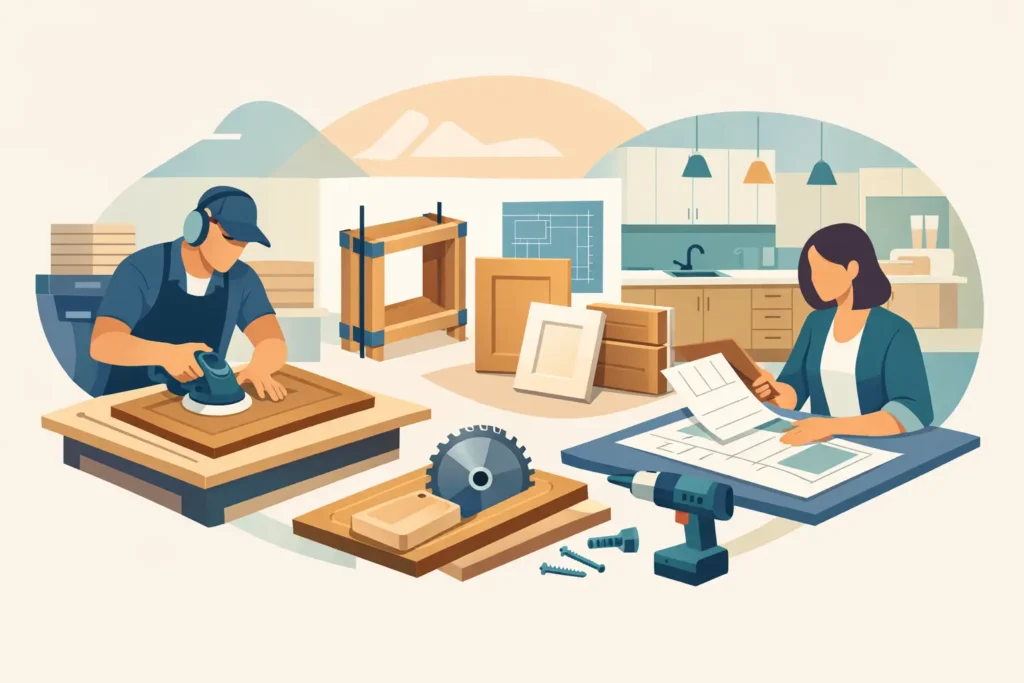
A kitchen that looks right in a brochure can still feel wrong in a real home. Ceilings are rarely perfectly level, walls are seldom truly straight, and everyday routines differ from one household to the next. That is exactly why homeowners often ask how custom kitchen cabinets are made, because the answer explains why a made-to-measure kitchen works so differently from an off-the-shelf one.
Custom cabinetry starts long before any board is cut. The process is part design, part manufacturing, and part problem-solving. When it is done properly, each stage builds on the last so the finished kitchen does not just fit the room, but also suits the way the household lives in it.
How custom kitchen cabinets are made from the outset
The first step is always understanding the space. A proper home survey records room dimensions, ceiling heights, wall positions, window and door openings, service points and any awkward features such as boxing, bulkheads or uneven floors. In older Dorset properties especially, those details matter. A few millimetres can affect how doors line up, how fillers are planned and whether an appliance housing will sit correctly.
This is also the stage where lifestyle matters as much as measurements. A keen cook may need wider drawer storage near the hob, while a family kitchen might need a harder-working island with seating, bins and charging points built in. Some clients want a classic painted look, others prefer a cleaner contemporary finish. The point of a bespoke cabinet is not simply that it can be made to any size. It is that the internal layout, proportions and finish can all be tailored with purpose.
Once the brief is clear, cabinet design begins. This includes overall elevations, internal storage planning, appliance integration, door style, material choice and the practical relationship between units. Tall housings, pan drawers, corner solutions, larders and wall units all need to work together as one scheme. Good design at this stage prevents expensive compromises later.
Design decisions shape the cabinet build
One of the biggest differences between custom and standard kitchens is that the cabinet dimensions are set by the room, not by a fixed catalogue. Standard units are usually produced in pre-set widths and heights. That can work, but it often means wasted space, oversized fillers or an awkward finish at the end of a run.
With custom kitchen cabinets, carcasses can be built to suit the exact requirement. That might mean deeper pan drawers, reduced-depth units for a narrow walkway, or a full-height cabinet designed to make proper use of an alcove. It also allows for cleaner lines. Instead of disguising gaps, the cabinetry is planned to reduce them.
Material choice also influences how cabinets are made. Cabinet carcasses are commonly produced from high-quality board materials chosen for stability, strength and consistency. Doors and visible end panels may be made from different materials depending on the style required. A painted shaker kitchen, for example, may use one construction method for doors and another for the cabinet body. A woodgrain finish may call for a different approach again.
There is no single best material for every kitchen. It depends on budget, finish, intended lifespan and the look the client wants. The right manufacturer will explain those trade-offs clearly rather than treating all cabinets as if they are the same.
Cutting, machining and cabinet production in the workshop
After design approval, the manufacturing phase begins. This is where drawings turn into physical components. Boards are cut to size with accuracy in mind, because consistency across every cabinet affects the final fit and appearance. Side panels, tops, bottoms, shelves, backs and service void allowances all need to be planned properly before assembly starts.
Machining follows cutting. Panels are prepared for fixings, shelf supports, hinges, drawer runners and other hardware. Precision here matters more than many people realise. If hinge positions or runner locations are even slightly off, door gaps can become inconsistent and drawer fronts can sit unevenly.
At this point, cabinet construction begins. Carcasses are assembled square and checked for strength. Depending on the design, backs may be recessed, service voids formed, and reinforcement added where stone worktops, integrated appliances or heavy internal storage will be used. These are not glamorous details, but they are some of the most important. A kitchen is opened, closed, loaded and cleaned every day. Long-term performance comes from sound construction, not just a smart showroom appearance.
For bespoke makers with their own workshop, production can also be more responsive. Adjustments are easier to manage when design, manufacture and installation teams work closely together. If a final site check highlights a small change, it can often be dealt with far more efficiently than in a mass-production system.
Doors, drawers and finishing details
Cabinets are only part of the story. Doors, drawer fronts, end panels, trims and cornices are what give the kitchen much of its character. These elements are made or prepared to match the design style, whether that is a simple slab door, a traditional in-frame look or a shaker style with a painted finish.
Drawer boxes and runners deserve attention too. Deep drawers are now doing much of the work once handled by base cupboards, so their quality matters. A well-made drawer should feel stable under load, open smoothly and close reliably year after year. The same is true for hinges. These parts may be hidden, but they have a direct effect on how premium a kitchen feels in daily use.
Finishing is where craftsmanship becomes visible. Painted cabinetry, for instance, needs careful preparation to achieve a durable and consistent result. Edges, joints and surfaces all need proper treatment before the final colour is applied. Wood finishes need equal care to bring out grain, maintain consistency and protect the material from kitchen wear.
This is also where bespoke kitchens can offer more control over the final look. Colour matching, custom panel sizes and made-to-measure feature pieces are all easier to achieve when the work is handled in-house rather than assembled from standard stock ranges.
How custom kitchen cabinets are made to fit your home
Manufacturing is only half the job. Fitting is where precision is tested. Even the best-made cabinets will not perform properly if they are installed poorly. Floors may need to be packed and levelled, walls may need scribing, and service positions must align with the planned layout.
During installation, base units are set out and levelled first, followed by wall units, housings, panels and trim details. Doors and drawer fronts are usually adjusted on site so reveals are even and movement is smooth. Worktops, splashbacks, lighting and appliances then need to integrate with the cabinetry correctly.
This stage is often where a full-service approach proves its value. Kitchens involve multiple trades, and timing matters. Plumbing, electrics, tiling, flooring and decoration all affect the finished result. If those elements are not managed together, delays and avoidable snags become more likely.
A custom kitchen should also account for serviceability. Access panels, removable plinth sections and sensible appliance housing design all make future maintenance easier. That may not be the first thing a client asks about, but it is part of building cabinetry that works well for years, not just on handover day.
Why bespoke production makes a difference
The real benefit of custom cabinetry is not simply exclusivity. It is suitability. A bespoke cabinet can make use of difficult corners, improve storage in compact rooms and create a cleaner finish in open-plan spaces where every line is visible. In many homes, that means a better result both practically and visually.
There are, of course, trade-offs. Custom kitchens are not the cheapest route, and they should not pretend to be. They involve more design input, more manufacturing attention and more installation care. But for homeowners who want a kitchen shaped around their home rather than adjusted to fit standard boxes, that investment usually shows in the finished room.
It also helps with continuity. If you want matching utility cabinetry, a replacement door in future, or coordinated fitted furniture elsewhere in the house, a company with in-house manufacturing can usually support that more reliably. For many clients, that accountability matters just as much as the design itself.
At Hale & Murray, we have seen time and again that the best kitchens are not the ones with the most features on paper. They are the ones made carefully, fitted properly and designed around real life from the very beginning.
If you are weighing up your options, it helps to look beyond door styles and colour charts. Ask where the cabinets are made, how the room is surveyed, what happens if site conditions are uneven, and who takes responsibility from design through fitting. The answers usually tell you far more than a price list ever will.