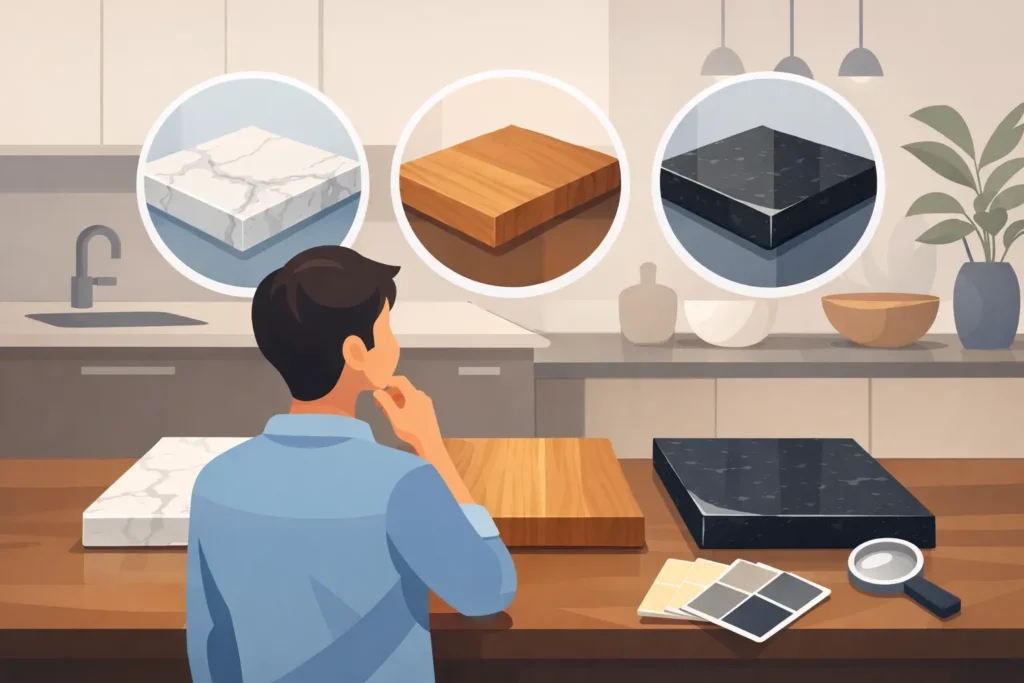
A worktop can look perfect in a showroom and still be the wrong choice for your kitchen. The real test comes later, when it is dealing with hot pans, school lunches, red wine, cleaning products and the general pace of everyday life. That is why knowing how to choose kitchen worktops is less about following trends and more about matching the material to the way you actually live.
How to choose kitchen worktops for real life
Most homeowners start with appearance, which is understandable. Your worktops take up a lot of visual space and have a big influence on the finished look of the room. But style on its own is not enough. A family kitchen in daily use needs something very different from a lightly used room in a second home or rental property.
A better way to choose is to balance four factors from the start: durability, maintenance, budget and design. If one of those is ignored, the decision often feels less successful a year or two down the line. The right worktop is the one that suits your routines as well as your cabinetry, flooring and lighting.
If you cook often, prepare food directly on the surface or have children using the kitchen throughout the day, resilience matters. If you want a cleaner, more architectural look, edge profile and thickness may be just as important as colour. If you are improving your home with long-term value in mind, it is worth looking past the cheapest upfront option and considering lifespan.
Start with how you use the kitchen
Before comparing materials, think honestly about what happens in your kitchen from Monday to Sunday. Some households need a hard-working surface that can cope with constant use, while others want a refined finish for a calmer, more design-led space.
If the kitchen is the centre of the home, you will want a worktop that is forgiving. That usually means good resistance to stains, scratches and moisture, with straightforward cleaning and no special treatment. If you cook only occasionally and want a distinctive natural finish, you may be happy to accept a little more maintenance in return for character.
This is often where trade-offs become clearer. A natural timber worktop can bring warmth and softness to a room, but it will need ongoing care. A polished stone surface may feel solid and luxurious, but some options are heavier, costlier and less practical if you are watching the budget closely. There is rarely one perfect answer for everyone.
Think about maintenance early
Maintenance is one of the most overlooked parts of choosing a worktop. Some materials need very little beyond regular wiping down. Others need oiling, sealing or more care around spills and heat.
If you know you want a low-fuss kitchen, be realistic. A surface that asks for careful treatment can become frustrating in a busy household. On the other hand, if you love natural materials and do not mind occasional upkeep, that same surface may feel entirely worth it.
Comparing the main kitchen worktop materials
The best way to understand how to choose kitchen worktops is to look at the strengths and limitations of each material in practical terms.
Laminate worktops
Laminate remains a popular choice because it offers good value and a wide range of finishes. Modern laminates can mimic stone, timber and concrete surprisingly well, and they suit many styles of kitchen.
For cost-conscious projects, laminate is often the most sensible place to start. It is relatively easy to maintain and works well in homes where appearance and budget need to be balanced carefully. The compromise is that it is generally less resistant to heat, impact and long-term wear than premium materials. Damage at joints or edges can also be harder to disguise.
Solid wood worktops
Solid wood brings warmth that many manufactured materials struggle to match. It works particularly well in classic kitchens, painted furniture and homes where a softer, more lived-in finish is welcome.
That said, timber is not a fit-and-forget option. It needs regular oiling and sensible day-to-day care, especially around sinks and wet areas. Scratches can often be sanded back, which is a benefit, but it will naturally change over time. For some homeowners that ageing is part of the appeal. For others, it is a drawback.
Quartz worktops
Quartz is one of the most requested options for good reason. It is durable, non-porous, easy to clean and available in a broad range of colours and patterns. If you want a neat, premium finish without the upkeep associated with some natural stones, quartz is often a strong choice.
It suits busy kitchens well and tends to appeal to homeowners who want confidence as much as style. The main consideration is price, as quartz is usually more expensive than laminate or timber. It is also worth noting that while quartz performs well in daily use, using trivets and sensible care around very high heat is still advisable.
Granite worktops
Granite offers a natural stone finish with depth, individuality and strong durability. No two slabs are exactly the same, which appeals to homeowners looking for something less uniform.
It can cope very well in a hard-working kitchen, but as a natural material it may require sealing depending on the specific product and finish. Granite can also vary more in appearance than engineered surfaces, so viewing samples alone is not always enough. Larger pieces give a truer sense of movement, tone and pattern.
Solid surface and other premium options
Solid surface materials are valued for their sleek appearance and the ability to create smooth joins and integrated features. They can work especially well in contemporary kitchens where a clean, streamlined result matters.
There are also specialist surfaces such as ceramic, porcelain and stainless steel, each with their own advantages. Ceramic and porcelain can offer excellent heat and scratch resistance, while stainless steel suits serious cooks and modern schemes. These are often best considered with professional guidance, as fabrication, edge detail and installation quality make a real difference.
Style matters, but so does proportion
A worktop should not be chosen in isolation. The colour, pattern, thickness and finish need to sit comfortably with the doors, handles, flooring and overall shape of the room.
In a smaller kitchen, a heavily patterned worktop can sometimes make the space feel busier than intended. In a larger open-plan room, a plain surface may need texture or contrast elsewhere to avoid looking flat. Pale worktops can brighten darker spaces, while deeper tones can add weight and definition to lighter cabinetry.
Thickness matters too. A slimmer profile often feels more contemporary, while a thicker edge can create a more traditional or substantial look. Neither is better in itself. It depends on the furniture design and the atmosphere you want to create.
Samples tell part of the story
Small samples are useful, but they do not always show the full picture. Veining, grain and reflective qualities can look quite different across a full run of worktop. Lighting also changes everything, especially in kitchens with strong natural light or a north-facing aspect.
This is where seeing materials in person can help avoid expensive second thoughts. A finish that looks ideal under showroom lighting may feel too cool, too busy or too dark once placed in your own home.
Budgeting without false economy
Worktops can represent a significant part of the kitchen budget, so it is sensible to be clear about priorities. Spending more is not always necessary, but choosing purely on lowest cost can be short-sighted if the material does not suit the room or wears poorly.
It often helps to ask what matters most. If longevity and low maintenance are high on the list, a mid- to premium-range surface may offer better value over time. If the kitchen is a short-term improvement before a future move or wider renovation, a well-chosen laminate may be entirely appropriate.
Installation should also be part of the calculation. A quality material can still disappoint if templating, jointing or fitting is poor. Precision matters, particularly around sinks, hobs, corners and any feature islands.
When expert guidance makes the difference
Knowing how to choose kitchen worktops becomes much easier when the advice is tied to your layout, your cabinetry and the way your household functions. That is where a proper design conversation earns its keep.
An experienced kitchen specialist can help you weigh appearance against practicality, explain what different materials are really like to live with and spot issues that are easy to miss early on. Things like unsupported overhangs, awkward joins, sink cut-outs and how a worktop meets upstands or splashbacks all affect the final result.
For homeowners investing in a bespoke kitchen, the benefit is even greater. When design, manufacture and installation are considered together, the worktop choice becomes part of a coherent plan rather than a last-minute add-on. That joined-up approach is something we value at Hale & Murray because it gives customers far more confidence in the finished room.
A good worktop should still feel right years after the installation team has left. If you start with how you live, what level of maintenance you are happy with and how long you want the kitchen to last, the right choice usually becomes much clearer.