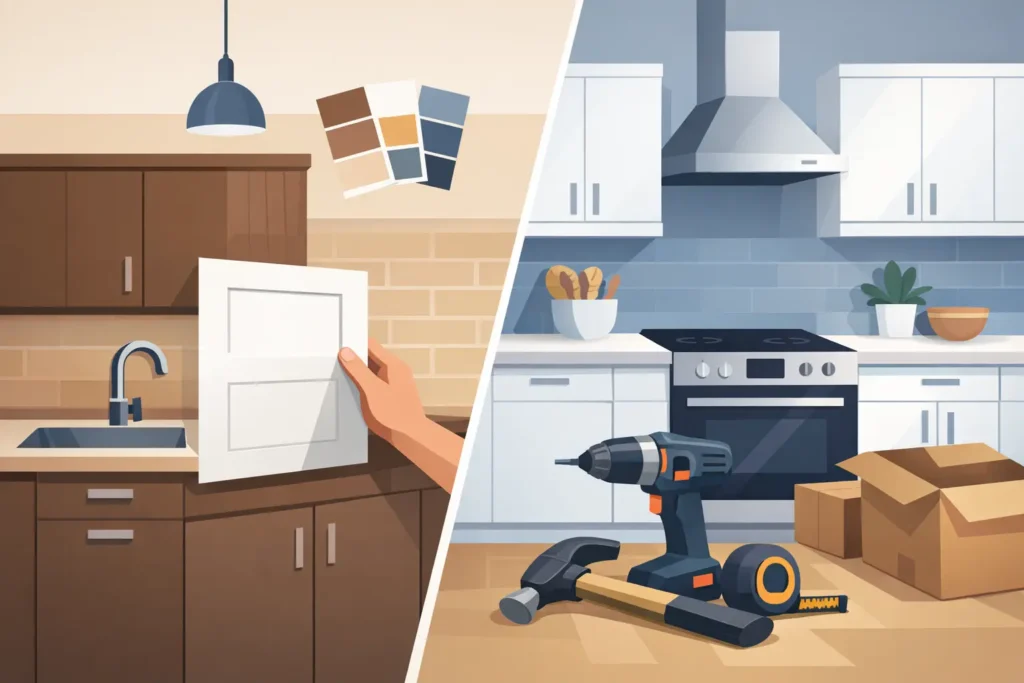
If your kitchen cabinets are looking tired but the room still basically works, the question is usually not whether to improve it, but how far to go. Kitchen refacing vs replacement is one of the most common decisions homeowners face when they want better style, better function and sensible value from the work.
The right answer depends on what is underneath the surface. Some kitchens need only a visual lift. Others look dated because they were poorly planned in the first place, with awkward storage, worn units and worktops that have reached the end of their life. That is where a quick fix can turn into false economy.
Kitchen refacing vs replacement: what is the difference?
Refacing means keeping the existing cabinet carcases and updating the visible elements. In practical terms, that usually includes new doors, drawer fronts, handles and often replacement end panels, plinths and worktops to refresh the overall look. If the cabinets themselves are sound and the kitchen layout already suits the way you live, refacing can make a dramatic difference without stripping the room back completely.
Replacement is a full restart. The old kitchen comes out, and new cabinetry, worktops and fittings go in. This gives you the chance to redesign the layout, improve storage, upgrade appliances, alter lighting, move plumbing or electrics and deal with any hidden problems behind the existing units.
On paper, the choice can look straightforward. In reality, it rests on a few key factors: condition, layout, budget, disruption and how long you plan to stay in the property.
When refacing makes sense
Refacing is often the right route when the cabinet boxes are still solid, level and well fitted. If the hinges are holding properly, the units have not swollen from moisture damage, and the arrangement of the kitchen already works well, replacing doors and surfaces can deliver a fresh result at a lower cost than a full new installation.
This is especially useful in homes where the kitchen feels dated rather than defective. You may dislike the style, the finish may be worn, or the worktop may have seen better days, but the sink, appliances and storage positions might all be in the right place. In that case, keeping the underlying structure can be a sensible use of budget.
It can also reduce disruption. A reface is generally less invasive than removing the whole kitchen, which matters if you are trying to minimise upheaval in a busy family home. For some households, that shorter programme is a major advantage.
That said, refacing only works when the base kitchen is worth saving. New doors fitted onto tired, damaged or poorly aligned cabinets will never feel quite right. If the bones are weak, the finish on top cannot compensate for that.
The strengths of refacing
The biggest benefit is value. You are not paying for completely new cabinetry or for the same level of removal and rebuild work. If your aim is to improve appearance rather than reimagine the room, that can be the most efficient approach.
Refacing can also be a good option for landlords, homeowners preparing a property for sale, or anyone who wants a smartened-up kitchen without committing to a full renovation. A door and worktop replacement can lift the whole room visually.
The limits of refacing
Refacing does not solve poor planning. If you have too little worktop space, awkward corner storage, cramped appliance positions or a layout that interrupts how you cook, those issues stay with you. You may end up with a kitchen that looks newer but still irritates you every day.
It also has design limits. The existing cabinet sizes and positions largely dictate the outcome, so you cannot achieve the same freedom you get with a made-to-measure replacement kitchen.
When replacement is the better investment
A full replacement tends to make more sense when the kitchen is failing structurally, functionally or both. Cabinets that are damaged, warped or badly fitted are poor candidates for refacing. So are kitchens with a layout that no longer reflects how the household uses the space.
This is often the case in older properties where the kitchen was fitted years ago for a different way of living. Open-plan living, integrated appliances, better recycling storage, wider drawers and more efficient use of corners have changed what people expect from a kitchen. If your current room feels cramped, dark or impractical, replacement gives you the chance to fix the real problem rather than mask it.
A new kitchen also offers better long-term value for homeowners planning to stay put. Instead of spending modestly now and then revisiting the room in a few years, it may be more sensible to invest once in a design that genuinely suits your home and daily routine.
What replacement allows you to change
With a new kitchen, the conversation goes far beyond doors and finishes. You can rework the layout, improve workflow, add tailored storage, change worktop materials, upgrade lighting and create a more cohesive result across the whole room. If building work, tiling or plumbing changes are required, they can be properly coordinated as part of one project rather than patched together later.
That matters in real homes, especially where walls are uneven, alcoves are awkward or standard-size units waste space. A bespoke approach can make use of every inch and produce a more balanced finish.
The trade-off with replacement
The main trade-offs are cost and disruption. Full replacement is a bigger investment and involves more trades, more decisions and a longer installation period. For some homeowners, that is entirely justified. For others, particularly if the current layout works well, it may be more than is necessary.
This is why honest assessment matters. Not every kitchen needs to be ripped out. Equally, not every kitchen should be kept just because some of it still looks serviceable.
Cost is only part of the story
Many people begin with budget, which is understandable, but kitchen refacing vs replacement should not be decided on price alone. Lower upfront cost does not always mean better value, and higher upfront cost is not automatically the wiser choice.
If refacing buys you another eight to ten years in a kitchen that already functions well, that can be money well spent. If it leaves you with old cabinet internals, limited storage and a layout you still dislike, the saving may feel less impressive quite quickly.
By contrast, a full replacement costs more, but it can solve multiple issues in one go and give you a kitchen designed around the way you actually live. For many households, especially those investing in a long-term home, that broader improvement is what makes the spend worthwhile.
How to decide which route suits your home
Start with the cabinet carcases. Are they solid, dry and properly fitted? Then look at the layout. Does it support the way you cook, store food and move around the room? Finally, think about your timeframe. Are you looking for a smart refresh, or do you want this next kitchen to serve you for many years?
It also helps to think practically about hidden works. If you already know the electrics need updating, the flooring needs attention, or the room would benefit from plumbing changes, those are signs that replacement may be the more coherent solution.
For homeowners in Poole, Bournemouth and the wider Dorset area, the best outcomes usually come from seeing the kitchen in person before deciding. A proper home visit can reveal whether the existing units are good candidates for refacing or whether a new fitted design would be the stronger long-term option. That kind of measured, hands-on advice often saves money by preventing the wrong choice.
A company with in-house manufacturing can also offer more flexibility than an off-the-shelf supplier. At Hale & Murray, for example, replacement doors and worktops can be a sensible solution where the original kitchen still has good structure, while a fully bespoke new kitchen makes far more sense when the room needs redesigning from the ground up.
The best choice is the one that fixes the real problem
A kitchen should not simply photograph well on day one. It should work properly on a busy Tuesday evening, hold up to daily use and feel right for the home it is in. If your existing kitchen is sound and only its appearance lets it down, refacing can be a practical and worthwhile answer. If the room is worn out, badly planned or no longer fit for purpose, replacement is usually the better investment.
The key is not choosing the cheaper option or the bigger project by default. It is choosing the route that matches the condition of your kitchen, your plans for the property and the standard of finish you want to live with every day.