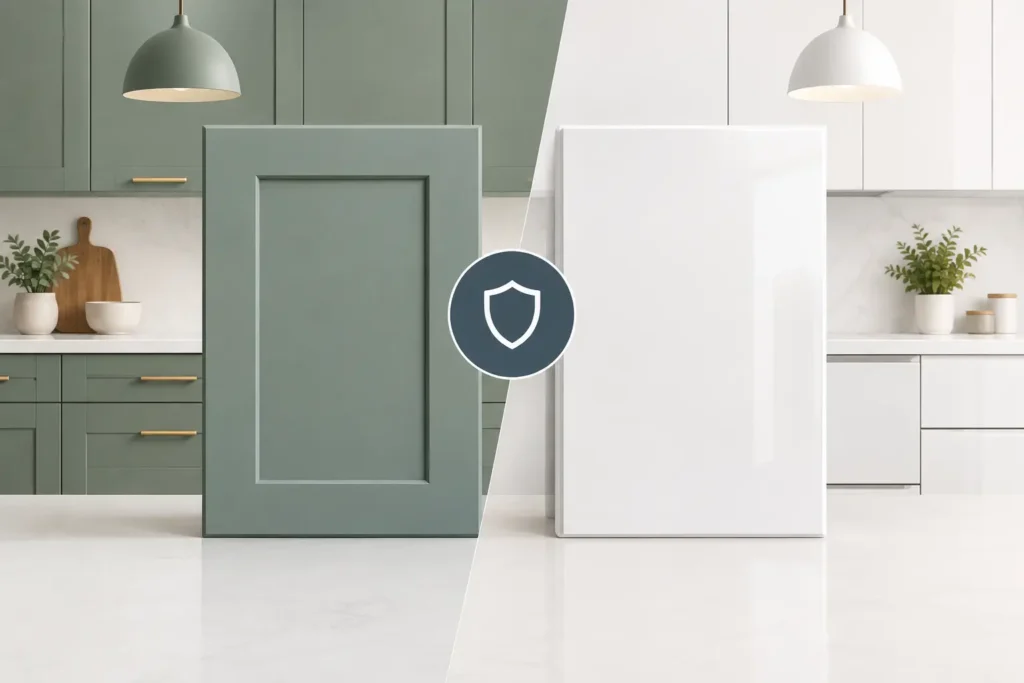
A kitchen door sample can look convincing under showroom lighting, yet its real test is a busy Tuesday evening: steam rising from the hob, wet hands at the sink, school bags against an island and repeated use of the same cupboard doors. When choosing painted or vinyl kitchen doors, the better option is not simply the one that looks best on day one. It is the finish that suits your household, your design priorities and how long you expect the kitchen to serve you.
For many Dorset homeowners, this is one of the most significant decisions in a kitchen project. Door finish affects the character of the room, the colour choices available, the way the kitchen ages and what can be repaired or refreshed later.
Painted or vinyl kitchen doors: the key difference
Painted doors are usually made from a stable timber-based board, such as MDF, with a sprayed paint finish. They may have a smooth modern face, a framed Shaker style or a more detailed traditional profile. The colour is applied as part of the manufacturing process rather than being a separate surface layer.
Vinyl doors, often described as vinyl-wrapped or foil-wrapped doors, are also commonly made from MDF. A decorative PVC vinyl film is heat-bonded around the shaped door, covering the face and edges in one continuous finish. This makes vinyl particularly effective for detailed profiles and practical, uniform finishes.
Neither is automatically superior. The question is whether you place greater value on colour freedom and future repairability, or on an easy-care, consistent finish at a typically lower initial cost.
When painted doors are worth the investment
A painted kitchen has a depth and softness that is difficult to replicate exactly with a wrapped surface. It works especially well where the kitchen is intended to feel individual rather than off-the-shelf. From quiet warm whites and heritage greens to deep blue-grey or a colour selected to complement existing flooring, paint gives far more scope to make the room your own.
This flexibility matters in a bespoke kitchen. A slightly awkward alcove, a period property or an open-plan room with strong natural light may call for a colour that is not available in a standard vinyl range. A painted finish allows the cabinetry to be designed around the home rather than asking the home to fit a limited palette.
Painted doors are also a strong long-term choice because small chips, marks and general wear can often be touched in or professionally refinished. A kitchen can be refreshed years later without necessarily replacing every cabinet. That is useful for households that expect their furniture to evolve with changing tastes.
There are trade-offs. Paint is not indestructible, and sharp impacts can chip it. Darker colours may make marks more visible, while very pale matt shades can show grime around handles if not cleaned regularly. Quality preparation, spraying and curing make a meaningful difference, which is why the construction and finish process should be discussed before comparing prices.
Best suited to homeowners who want choice
Painted doors suit homeowners who want a particular shade, a classic Shaker look, a handleless contemporary scheme with a soft matt appearance, or the option to repaint in future. They are often the natural fit for a long-term renovation where individuality and repairability carry real value.
Where vinyl kitchen doors make sense
Vinyl doors have earned their place for good reason. They offer an attractive, consistent finish and can be a sensible way to achieve a smart fitted kitchen while keeping tighter control of the budget. Because the vinyl wraps around the edges, there are no painted edge lines to consider, and many finishes are straightforward to wipe clean.
They are available in a broad selection of colours, wood effects, glosses and matt finishes. For a rental property, a first kitchen renovation, a utility room or a busy family kitchen where practicality takes priority, vinyl can be a very sensible specification.
The finish is also well suited to shaped doors. A traditional routed profile can be covered evenly in vinyl, producing a neat result without the additional finishing stages associated with paint. For those who prefer a familiar cream, white, grey or woodgrain kitchen, the available choice may be more than enough.
The limitation is that vinyl is a surface film. If it is deeply scratched, torn or begins to lift at an edge, it cannot be invisibly touched up in the same way as a painted door. Heat, steam and poor ventilation can place extra strain on any kitchen finish, but these factors are particularly relevant close to kettles, ovens and dishwashers. A well-designed kitchen should allow for ventilation, appropriate clearances and sensible positioning of appliances whatever door material is chosen.
Best suited to practical, budget-aware projects
Vinyl is often a good choice where a durable, neat finish is needed without the additional cost of a painted specification. It can be particularly effective in utility spaces, buy-to-let homes and projects where the selected vinyl colour and door style already deliver the desired look.
Durability is about more than the door finish
It is tempting to compare painted and vinyl doors as though the finish alone determines quality. In practice, the cabinet construction, hinges, drawer runners, fitting standards and everyday care have just as much influence on how a kitchen performs.
A carefully made painted door will not compensate for poorly aligned units or inadequate hinges. Equally, a good-quality vinyl door on well-built cabinets can give many years of reliable service. Look closely at the whole specification: the thickness and construction of the carcasses, edge treatment, quality of hardware, ventilation around appliances and how the kitchen will be installed.
For homes near the coast, day-to-day moisture management is especially worthwhile. Use the extractor when cooking, wipe condensation from doors and do not leave a dishwasher open immediately after a cycle with steam directed at neighbouring furniture. These are small habits, but they protect worktops, cabinetry and door finishes alike.
Cleaning and maintenance in real life
Both finishes benefit from gentle cleaning with a soft cloth, warm water and a mild detergent. Avoid abrasive pads, scouring powders, harsh solvents and strong spray cleaners. They can dull painted surfaces and may damage or discolour vinyl over time.
Painted doors may need occasional care around handles, lower cupboards and bin units, where hands and bags create more contact. This is not a reason to avoid paint, but it is worth choosing a finish and colour with honest expectations about family life. A mid-tone matt colour is often more forgiving than brilliant white or very dark navy.
Vinyl is generally easy to maintain, but check edges and corners as part of routine cleaning. If an edge is damaged, dealing with it early gives the best chance of preventing further lifting. Do not attempt aggressive gluing or heating at home, as this can worsen the appearance and make a later repair more difficult.
How to choose for your kitchen style and budget
Start with the room rather than a door sample. Consider how much daylight enters the kitchen, whether it opens into a living area, the age and character of the property, and whether you want the cabinetry to be a quiet backdrop or a defining feature. Then think about the next ten years, not only the installation date.
Choose painted doors if colour choice, a premium tailored appearance and the ability to repair or repaint matter most. Choose vinyl if you want a cost-conscious, low-maintenance finish and are happy with an established range of colours and styles.
It is also possible to mix priorities. A painted kitchen may be right for the main room, while vinyl furniture provides a hard-working and economical answer in a utility or boot room. The best scheme is one that allocates the budget where it will make the greatest difference to daily use.
At Hale & Murray, doors can be considered alongside layout, worktops, appliances and the practical demands of the household, rather than as an isolated showroom decision. Seeing samples in person and discussing how they will be made, fitted and maintained gives a much clearer basis for choosing.
Before committing, take home samples if possible and view them in morning, afternoon and artificial light. Place them beside your flooring, wall colour and worktop choice. The right door is the one that still feels considered after the initial excitement of a new kitchen has settled – and that you will be happy to use every day.