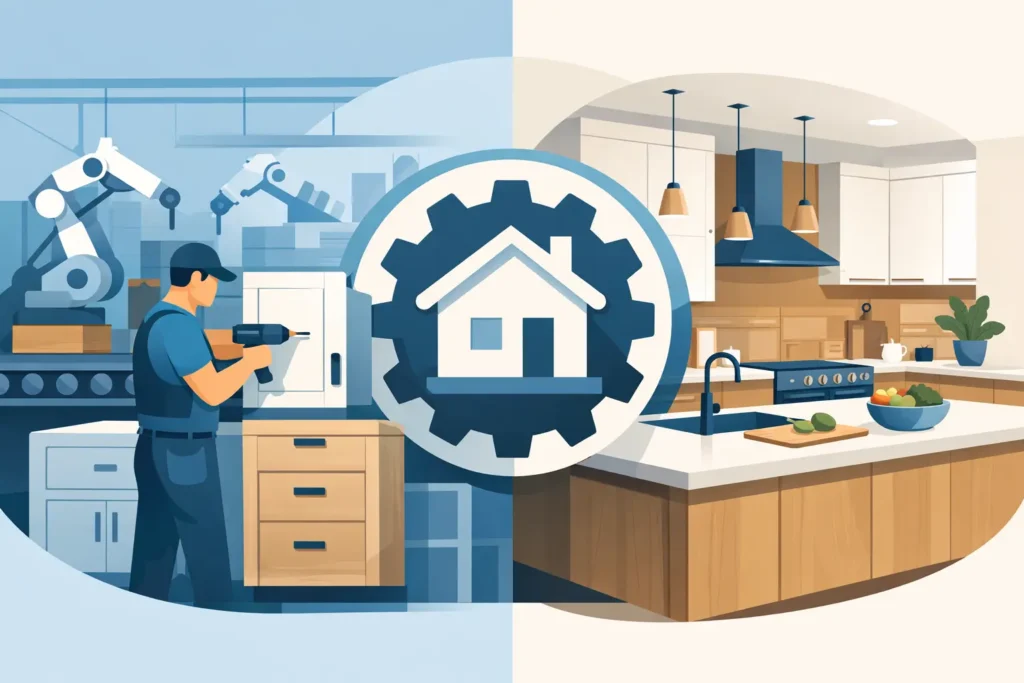
A kitchen can look impressive in a brochure and still be wrong for the way you live. The real test comes when awkward walls, uneven floors, boiler housings, storage needs and family routines all have to work together. That is where in house kitchen manufacturing makes a noticeable difference, because the people designing the room are working closely with the people making it.
For homeowners planning a new kitchen, that link matters more than many realise at the outset. It affects how accurately the design responds to the room, how quickly adjustments can be made, how consistent the finish is, and how straightforward the installation becomes. If you are investing in fitted furniture for the long term, those details are not extras. They are often the difference between a kitchen that simply looks good and one that works well every day.
What in house kitchen manufacturing really means
The phrase gets used quite loosely, so it is worth being clear. In house kitchen manufacturing means the cabinetry and fitted components are made by the company itself, rather than being ordered entirely from a third-party factory and passed on through a showroom or sales office.
That does not mean every single element of a kitchen is made from raw material under one roof. Appliances, specialist ironmongery, sinks and some worktop materials will still usually come from established suppliers. What matters is that the core fitted furniture is being produced by the same business that is measuring, designing and managing the job.
That direct control changes the process. Instead of trying to make a standard range fit a non-standard home, the furniture is built around the room and the customer. In older properties around Poole, Bournemouth and the wider Dorset area, where walls are rarely perfectly straight and existing services can create awkward restrictions, that flexibility is especially valuable.
Why in house kitchen manufacturing gives homeowners more control
When manufacturing sits within the same business as design and installation, there is less room for crossed wires. The person discussing cabinet widths, storage preferences and finishes is not sending a generic order into a distant system and hoping the result matches the brief. There is a closer working relationship between concept and production.
That tends to show itself in practical ways. A filler panel can be adjusted to suit a difficult corner. A cabinet depth can be altered to improve circulation. A housing can be designed around pipework or structural features without making the room feel compromised. Those are small decisions individually, but together they shape how bespoke a kitchen really is.
There is also more accountability. If one company is responsible for design, manufacture and installation, there is no uncertainty over who owns a problem or who should put it right. For customers, that brings peace of mind. You are not dealing with a chain of suppliers where responsibility can become blurred once the order is placed.
The quality difference is often in the details
A well-made kitchen is not only about the door style or the choice of colour. It is about how cabinets are constructed, how well components line up, how neatly awkward areas are resolved, and how the finished room stands up to daily use.
In house kitchen manufacturing allows greater oversight at each stage. Materials can be selected for the project in hand. Dimensions can be checked against real site measurements. Finishing details can be reviewed before units ever arrive in the customer’s home. That level of scrutiny is harder to achieve when furniture is coming in as a fixed package from elsewhere.
It also helps with consistency. In bespoke work, especially across larger kitchens or projects that connect to utility rooms, home offices or living spaces, continuity matters. Proportions, panel details and finishes need to work as a whole. A manufacturer working directly from the agreed design can maintain that cohesion more effectively than a pieced-together approach.
That said, bespoke manufacture is not about claiming that every standard product is poor. Many factory-made ranges are perfectly serviceable. The question is whether they are right for your home, your priorities and the level of finish you expect. If your room is straightforward and your brief is simple, a standard solution may be enough. If your property needs careful planning and a tailored fit, the value of in-house production becomes much clearer.
Lead times, adjustments and the benefit of being local
One of the less obvious benefits of in house kitchen manufacturing is responsiveness. Projects rarely move in a perfectly straight line. A wall may need more work than expected. A dimension may change once plaster is removed. A customer may decide they want a different internal storage arrangement after seeing the plan in more detail.
When manufacturing is handled locally by the same business, those changes are usually easier to manage. There is no need to restart a slow external ordering process for every revision. Decisions can be reviewed quickly, and practical amendments can be made with a better understanding of the site conditions.
This can also support shorter lead times, although it depends on workload and the complexity of the project. Bespoke does not always mean faster. A highly detailed kitchen still takes time to produce properly. But local in-house production often removes some of the delays that come with relying entirely on national supply chains and fixed-range ordering windows.
For homeowners, the real benefit is not speed alone. It is confidence that the schedule is being managed by the same team that is building the furniture and planning the installation.
Better fit, especially in real homes rather than perfect rooms
Very few homes offer the kind of blank-canvas room shown in magazine photography. There may be chimney breasts, sloping ceilings, boxed-in services, narrow walkways or uneven alcoves. In extensions and renovation projects, there can also be structural changes that affect the final layout once work is underway.
This is where bespoke manufacture earns its keep. Cabinets can be made to exact dimensions rather than forcing the room to accept standard sizes. Storage can be planned around how the household actually uses the space, whether that means deeper pan drawers, a compact breakfast cupboard, hidden recycling, or built-in seating that makes use of an otherwise wasted area.
For many customers, the aim is not to create something extravagant. It is simply to avoid obvious compromises. A kitchen should feel settled in the room, not dropped into it.
Aftercare is stronger when the maker is still involved
A kitchen is a major purchase, and questions do not always end on installation day. You may want matching furniture later, a replacement door, an updated worktop, or help with an adjustment after the room has been in use.
When the original manufacturer is still part of the business relationship, those conversations are often easier. The specifications are known, the construction methods are familiar, and there is a clearer route to supplying compatible pieces in future.
That continuity is particularly useful for customers who see fitted furniture as a long-term investment rather than a one-off transaction. Homes change over time. A family kitchen may later need to suit different routines, updated appliances or a fresh finish. Working with a company that can still make and adapt products to suit the original installation gives you more options down the line.
Is in house kitchen manufacturing right for every project?
Not always, and it is better to be honest about that. If your priority is the lowest possible upfront cost, a standard off-the-shelf kitchen may be the better fit. Bespoke manufacture involves skilled labour, careful planning and a more tailored production process, so the investment is typically higher.
The trade-off is value over time. A kitchen designed for the room, manufactured with care and installed under close project management is more likely to deliver the finish, function and durability many homeowners are actually looking for. It can also reduce the frustration that comes from trying to force standard products into an individual property.
For customers who want personal service, accountable workmanship and furniture made with their home in mind, this approach makes strong practical sense. That is why businesses such as Hale & Murray continue to invest in workshop-based production rather than relying solely on bought-in ranges.
If you are weighing up suppliers, ask a simple question early on: who is actually making the kitchen, and what does that allow them to do differently for your home? The answer usually tells you a great deal about the standard of service you can expect.