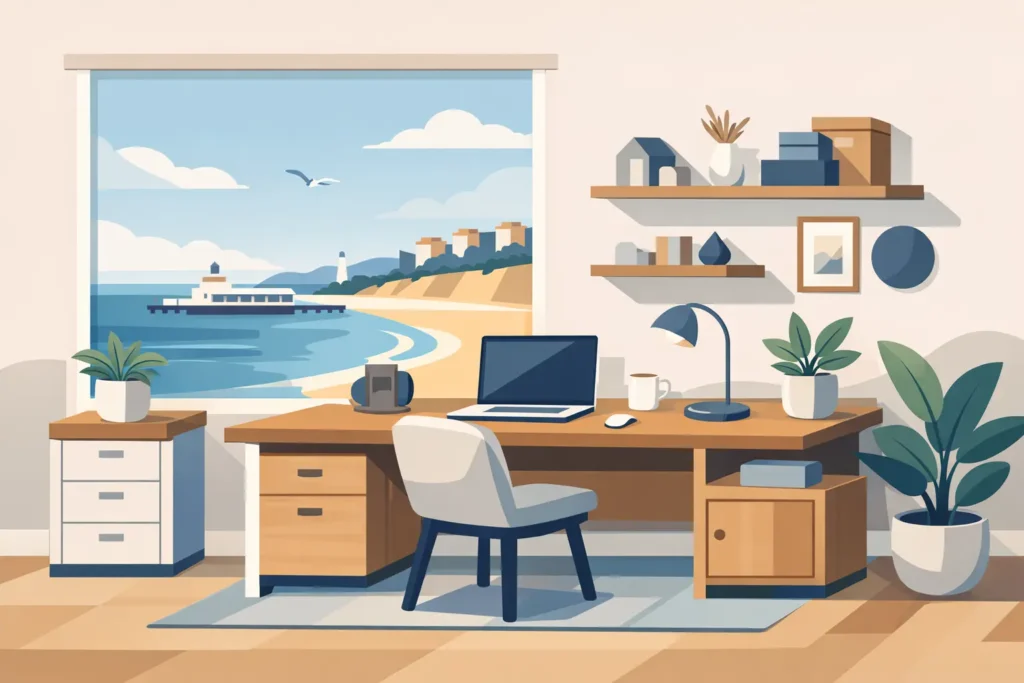
A spare bedroom with a desk pushed against the wall might work for a few weeks. It rarely works for years. If you are planning a bespoke home office Bournemouth homeowners can use every day, the difference comes down to how well the room fits your work, your house and the way you actually live.
For some people, that means a calm, professional backdrop for video calls. For others, it means enough filing, printer space and concealed cabling to keep the room tidy when the working day ends. A well-designed fitted office should do more than hold a desk. It should make the room easier to use, easier to maintain and more comfortable to spend time in.
Why a bespoke home office in Bournemouth makes sense
Homes across Bournemouth and the wider Dorset area vary enormously. Period properties often come with alcoves, chimney breasts and uneven walls. Newer homes can present the opposite problem – boxy rooms with limited floor area and very little built-in storage. In both cases, off-the-shelf furniture tends to waste space.
That is where bespoke design earns its place. A fitted home office can be built around awkward corners, sloping ceilings, window positions and the exact width of the room. Instead of trying to make standard furniture fit, the furniture is made to suit the room.
There is also a practical point that is often overlooked. Working from home changes how a house functions. A room that once needed only a chest of drawers or a guest bed may now need proper task lighting, charging points, hidden storage, shelving, and a desk height that supports long hours of use. Getting those details right early tends to save frustration later.
What makes a home office feel properly fitted
The best fitted offices are not simply more expensive versions of freestanding desks. They solve specific problems. A full-width desk can create a generous working surface without making the room feel cramped. Built-in cupboards can hide printers, paperwork and tech. Shelving can be arranged around the items you genuinely use rather than forcing you to adapt to fixed sizes.
Balance matters. Too much open shelving and the room starts to feel busy. Too many closed cupboards and it can feel heavy, especially in a smaller space. Good design usually mixes the two, with display space where it adds character and enclosed storage where it keeps clutter out of sight.
Finish matters as well. A home office should sit comfortably within the rest of the property, particularly if the room is visible from a landing or used for other purposes as well. Some clients prefer a classic, furniture-led look that feels in keeping with a traditional home. Others want cleaner lines and a simpler finish. Neither approach is right for everyone. It depends on the house, the amount of natural light and how formal you want the room to feel.
Planning a bespoke home office Bournemouth property owners will use every day
Before thinking about colours or handles, it helps to be honest about how the room will be used. One person working quietly at a laptop has very different requirements from a household where two people need shared desk space, storage for files and room for a monitor, scanner and printer.
A practical design conversation usually starts with routine. Do you need a large desktop or just enough space for a screen and notebook? Do you take video calls and want a tidy background? Will the room double as a guest room or dressing room? Are children using the space for homework after school? These points shape the furniture far more than trends do.
Storage is another area where precision helps. Deep cupboards are useful, but only if what you are storing suits the depth. Shallow shelving can be better for paperwork and books because everything stays visible. Drawers are often ideal for small office items, while full-height cupboards can keep less attractive essentials tucked away. The most successful layouts give every category of item a home.
Then there is ergonomics. A desk that looks smart but feels awkward by mid-afternoon is not doing its job. Screen height, leg room, chair clearance and reach to sockets all matter. If the office is being used five days a week, comfort is not an extra.
Design details that make daily work easier
Cable management is one of the clearest differences between a room that looks good in photographs and one that works in real life. Chargers, monitors, lamps, routers and printers create visual clutter quickly. A bespoke setup can allow for discreet routes, access points and housing for equipment so the room stays cleaner and easier to use.
Lighting deserves equal attention. Natural daylight is valuable, but it is rarely enough on its own, particularly during darker winter afternoons. A good home office often combines overhead lighting with focused task lighting and, where possible, avoids placing screens where glare becomes a daily irritation.
Acoustics can matter too, especially in busy family homes. Fitted furniture, upholstered seating and better use of wall space can help soften noise. It will not soundproof a room completely, but it can improve concentration more than many people expect.
The finish of the furniture also affects how the room feels over time. Light tones can help smaller spaces feel more open. Richer finishes can add warmth and presence. Matte surfaces often create a quieter, more understated look, while timber textures can make a workspace feel less clinical. The right choice depends on the room and on whether you want the office to feel distinctly separate from the rest of the home or naturally connected to it.
Why local manufacturing changes the result
One of the biggest advantages of choosing a true fitted furniture specialist is control. When furniture is manufactured to order rather than pulled from a standard range, there is more freedom to tailor the design properly. Sizes, proportions, finishes and internal layouts can be adjusted to suit the room instead of forcing compromise.
It also tends to improve accountability. When the same business handles design, manufacture and installation, there is less room for crossed wires between supplier, fitter and subcontractor. Problems are easier to resolve because responsibility is clearer.
For homeowners in Bournemouth, this local approach often brings practical benefits too. Home visits, detailed measuring and access to a showroom can make decisions simpler. Seeing finishes in person is useful. So is speaking to people who understand the age, style and quirks of homes across the area.
A company with its own workshop can also be more flexible when a room calls for something out of the ordinary. That might be a desk shaped around an alcove, storage built into eaves, or a full wall of cabinetry designed to blend work and household storage in one room.
The trade-offs to consider before you go ahead
Bespoke furniture is an investment, and it is sensible to treat it as one. It will usually cost more than buying a desk, shelves and storage separately. The value comes from fit, durability, appearance and long-term usefulness rather than the lowest upfront price.
It is also worth thinking about how fixed you want the room to be. Built-in furniture brings a much more polished result, but it is less flexible to move around on a whim. For most homeowners, that is a worthwhile trade if the design has been properly thought through. It simply means planning matters.
Lead time is another consideration. A made-to-measure office takes longer than picking up standard furniture. But in return, you get something designed around your home rather than a compromise you may replace in a few years.
Choosing the right company for a bespoke home office Bournemouth project
This is the stage where experience shows. A good fitted furniture company should ask practical questions, not just talk about finishes. They should want to know how you work, what you need to store, how the room connects with the rest of the house and what problems the current setup creates.
It also helps to choose a business that can take ownership of the whole process. Design is important, but so are accurate surveying, manufacturing quality and careful installation. For a room you will use regularly, those details shape whether the final result feels well finished or merely fitted in.
As a long-established local family business, Hale & Murray sees this first-hand. Home offices work best when they are treated with the same care as any other fitted interior – measured properly, made properly and installed with clear accountability from start to finish.
A bespoke home office should make your day easier, not simply fill a room with attractive furniture. When the design is built around your routine, your storage and your space, the room starts to work harder for you from the moment you sit down.