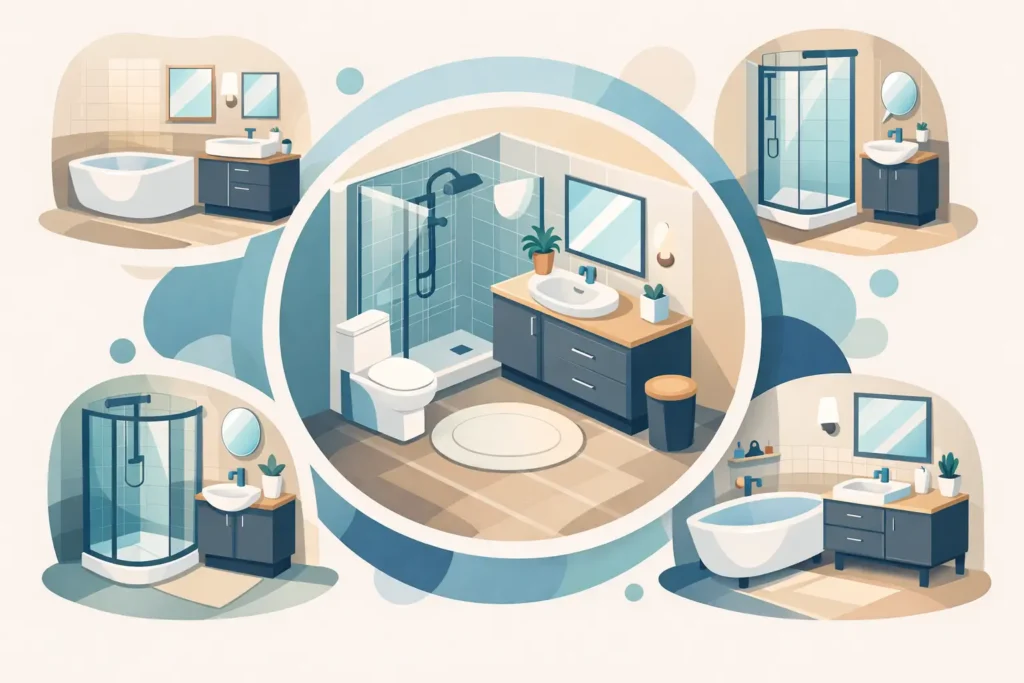
A small bathroom usually tells on itself in the first few seconds. The door clips the towel rail, the basin feels too close to the loo, and there is nowhere sensible to put the everyday essentials. That is why the best small bathroom layout ideas are rarely about squeezing in more. They are about making the room work properly.
In our experience, a successful small bathroom starts with movement. You need enough space to enter, dry off, open storage and clean the room without feeling like every fitting is in the way. Once that is right, the look of the room becomes much easier to solve. Good layout does the heavy lifting.
What makes the best small bathroom layout ideas work
Small bathrooms do not all have the same problem. Some are long and narrow. Some are almost square but awkwardly placed around a window or soil pipe. Others lose valuable floor area to boxing, sloping ceilings or a door swing that takes up half the room. The best layout depends on the shape of the room first, and the shopping list second.
That is often where homeowners get caught out. It is tempting to begin with a freestanding vanity you like online or a bath you have seen in a showroom. In a compact room, though, proportions matter more than individual pieces. A 50mm saving on basin depth or a better door position can make the difference between a bathroom that feels cramped and one that feels considered.
A practical layout also needs to reflect who is using the room. A downstairs cloakroom has different demands from a family bathroom. A room used by downsizers may benefit from easier access and less bending. A children’s bathroom often needs hard-wearing surfaces and straightforward storage. There is no single perfect formula, but there are clear patterns that tend to work well.
Best small bathroom layout ideas for common room shapes
The one-wall layout
If your plumbing can be grouped on one side, a one-wall layout is often the neatest option in a very narrow room. The basin, WC and shower sit along the same wall, leaving a clearer route through the space. It can make the room feel calmer because fittings are not competing from both sides.
The trade-off is that every item needs careful spacing. If pieces are too close together, the room looks pinched and becomes harder to clean. Slimline fittings help here, particularly a reduced-depth vanity and a compact WC projection.
The end-shower layout
For a rectangular bathroom, placing the shower across the short end of the room usually makes good use of the footprint. It creates a strong visual stop, and the rest of the fittings can run along one side or opposite each other with better balance.
This works particularly well with a walk-in glass screen, as a bulky enclosure can make the room feel chopped up. If privacy is a concern, fluted or lightly frosted glass can soften the view without making the room feel boxed in.
The bath-with-shower-over layout
When a family bathroom must include a bath, combining it with an overhead shower is often the most sensible use of space. In a small room, trying to fit a separate shower and bath can force every element to become too small to use comfortably.
That said, this layout only works if the bath is practical to stand in and the screen is properly sized. A short screen or poorly placed taps can make showering awkward. Families with young children often find this arrangement ideal, while households who mainly shower may be better served by a generous shower instead.
The corner-entry layout
In near-square bathrooms, corner planning can unlock awkward dead space. A corner basin or corner shower enclosure can free up the middle of the room and improve circulation. This is especially useful where the door opens into the room and the available wall lengths are broken up.
The caution here is to avoid novelty for its own sake. Some corner fittings save space on paper but feel compromised in daily use. A layout should not only fit – it should feel natural.
Small bathroom layout ideas that create more usable space
The biggest gains in a compact bathroom often come from the details around the layout, not just the layout itself.
Wall-hung furniture is one of the most effective choices. Raising the vanity and WC off the floor exposes more visible floor area, which helps the room feel larger and makes cleaning easier. It also gives more flexibility with positioning because pipework can often be concealed more neatly.
Pocket or outward-opening doors can transform a tight room if the structure allows for it. A standard inward-opening door claims a surprising amount of usable space. If changing the door type is not practical, even rehanging it to open against the least useful wall can help.
Recessed storage matters more than many people expect. In a small bathroom, shelves and cabinets that project too far can create constant pinch points. Building storage into stud walls, niches or over-boxing keeps essentials close at hand without making the room feel crowded.
Large-format tiles can also support the layout visually. Fewer grout lines usually make a compact room feel calmer and more open. This is not really a layout choice, but it strengthens a well-planned layout by reducing visual fuss.
How to prioritise fittings in a small bathroom
One of the most useful exercises at the design stage is to decide what matters most. In the best small bathroom layout ideas, something usually gives a little so that something else can work better.
If a proper vanity with drawer storage is high on your list, you may need a slightly smaller basin or a shower tray with cleaner lines. If easy-access showering is the priority, it may be worth giving up the bath. If the room is used by guests, a neat appearance may matter more than maximum storage. If it is the main family bathroom, hidden storage tends to rise to the top of the list very quickly.
This is where bespoke design has a real advantage. Off-the-shelf bathroom furniture is built to standard sizes, but older properties and compact modern homes rarely behave in standard ways. Made-to-measure pieces can be reduced in depth, adjusted in width or designed around awkward features so the room feels intentional rather than fitted around compromises.
Best small bathroom layout ideas for storage without clutter
Storage in a small bathroom should support the layout, not interrupt it. Tall cabinets can work well if they are slim and placed where they do not crowd the basin area. Mirror cabinets are useful because they add storage without consuming extra wall space. Vanity drawers often outperform cupboards because they make the full depth easier to reach.
It also helps to think about what should live in the room permanently. Towels, cleaning products, spare loo rolls, toiletries and children’s bath items all need different kinds of storage. If everything has to be stored in one small space, the layout needs to allow for that from the start. If some items can live in a nearby airing cupboard or linen store, the bathroom itself can stay simpler.
Open shelving can look attractive, but in a compact bathroom it needs discipline. Too much on display quickly makes the room feel busy. Closed storage is usually the safer choice when the aim is a tidy, easy-to-maintain finish.
Mistakes that can ruin a small bathroom layout
The most common mistake is choosing fittings that are individually appealing but collectively too large. A broad basin, a deep radiator and a chunky toilet frame may all fit, yet still leave the room awkward to move around.
Another issue is ignoring door swings, drawer openings and standing space. A bathroom can look fine on a plan and still fail in use because there is nowhere comfortable to stand at the basin or step out of the shower.
Lighting can also undermine a good layout. In a small room, shadows make corners feel tighter and mirrors less useful. Layered lighting, especially around the vanity, helps the room feel more open and practical.
Finally, do not overlook installation realities. Pipe runs, waste positions, floor levels and wall construction all affect what is sensible. The best-looking layout on paper is not always the best one to build. Honest advice at this stage prevents expensive changes later.
Getting the layout right from the beginning
A well-planned small bathroom should feel straightforward. You walk in easily, everything is where you expect it to be, and there is enough storage to keep surfaces clear. That result usually comes from careful measuring, sensible product choices and a willingness to prioritise what will improve everyday use.
For homeowners in Poole, Bournemouth and the surrounding area, this is often where an experienced fitted interiors specialist earns their keep. The room may be small, but the decisions are not. When the layout is tailored properly to the building and the people using it, even a compact bathroom can feel calm, capable and built to last.
If you are planning a new bathroom, start with the space you have rather than the products you have seen. The right layout will make every later decision easier, and the room will reward you every day you use it.