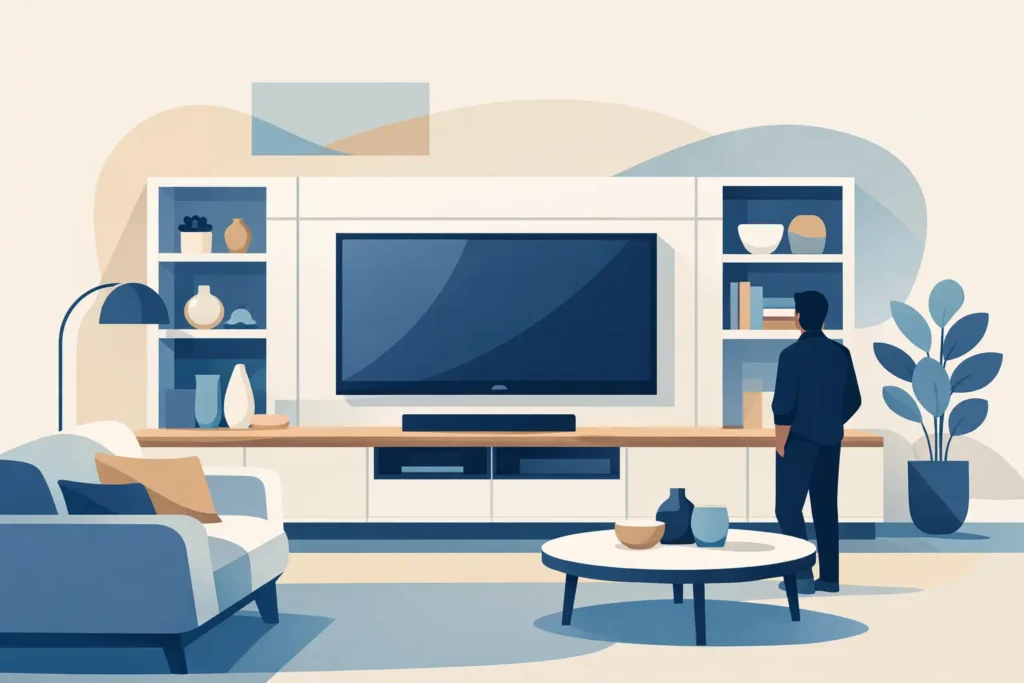
A television on a stand can do the job, but it rarely makes the room feel finished. Wires stay visible, storage ends up mismatched, and the wall behind the screen becomes wasted space. Built-in media wall furniture changes that by turning one of the busiest parts of the lounge into something purposeful, tidy and well balanced.
For many homeowners, the appeal is not just appearance. It is about making the room work better every day. A properly designed media wall can hide cables, house sound systems, provide storage for books and games, display decorative pieces, and make the television feel integrated rather than simply placed there as an afterthought.
Why built-in media wall furniture works so well
The main advantage of fitted furniture is that it is designed around the room rather than forced into it. Alcoves, chimney breasts, awkward corners and uneven walls are common in British homes, especially in period properties and altered layouts. Off-the-shelf units often leave gaps, waste depth or sit awkwardly against skirting boards and sockets.
Built-in media wall furniture uses the available space properly. That could mean full-height cabinetry around a central screen, low fitted units running wall to wall, or a more understated arrangement that combines shelving and concealed cupboards. The result is usually calmer to look at because everything has a place and the proportions feel right for the room.
It also gives you far more control over how the lounge functions. Some households want a clean, minimal look with almost everything hidden away. Others want open shelving for books, framed photographs or collected pieces. Most people need a sensible mix of both. Bespoke design allows that balance to be set around your routine rather than around standard unit sizes.
What to plan before choosing built-in media wall furniture
The television size is the obvious starting point, but it should not be the only one. A media wall needs to be planned around viewing distance, seating layout and how the room is used at different times of day. A large screen may look impressive in a showroom, yet feel overpowering in a modest lounge if the furniture around it is not scaled carefully.
Storage needs deserve just as much attention. It helps to be honest about what the unit must hold. Set-top boxes, routers, games consoles, speakers, remotes, records, toys, paperwork and decorative items all demand different depths and access. If these details are skipped at the design stage, the finished result can look smart but feel inconvenient.
Cable management is another area where proper planning matters. A built-in installation should account for plug sockets, aerial points, internet connections, ventilation and access for future changes. Technology changes quickly, so a design that allows some flexibility is usually wiser than one built too tightly around a single device.
Lighting can also alter the whole effect. Integrated shelf lighting or subtle feature lighting around the display area can add warmth and depth, but it needs restraint. Too much illumination can make the wall feel busy, especially in a room meant for relaxing in the evening.
Design choices that make a media wall look considered
Good media wall design is rarely about adding more. It is usually about getting proportions, lines and finishes right.
One of the most effective approaches is to treat the television as part of a wider composition. That might mean symmetrical cabinetry either side of a chimney breast, or it might mean a more contemporary asymmetric layout with offset shelving and lower storage. The best option depends on the architecture of the room and the look you prefer.
Finish choice matters as much as layout. Painted fitted furniture can feel classic and adaptable, especially in softer neutral shades. Woodgrain finishes can bring warmth and texture, which is useful if the room needs to feel less flat or formal. Matt surfaces often work well in lounges because they keep reflections down and sit comfortably beside a screen.
There is also a balance to strike between display and concealment. Open shelves can look attractive, but only if they are not overloaded. Too many visible items can make the whole wall feel cluttered again. Closed cupboards are practical for the things you need nearby but do not want on show. In most homes, combining the two gives a better long-term result than leaning too far in either direction.
Common mistakes to avoid
The most common mistake is designing the wall around a picture rather than around real use. Images of dramatic feature walls can be appealing, but what suits one room may not suit another. A design that looks striking online may dominate the space, reduce useful storage or date quickly.
Another mistake is underestimating joinery quality. Large fitted pieces need to cope with daily use, changing temperatures and the visual demands of a prominent room. Poorly made units, thin materials or rushed fitting can spoil the overall effect very quickly. In a media wall, where straight lines and alignment are highly visible, workmanship shows.
Overbuilding is another risk. Not every wall needs shelving from floor to ceiling. In some rooms, a lower run of fitted furniture with a neatly mounted screen above will feel more elegant and leave the space lighter. It depends on ceiling height, room width and how much storage you genuinely need.
Then there is the issue of future proofing. If access panels, removable backs or service voids are ignored, even a simple equipment swap can become awkward later. A good design should feel permanent without being inflexible.
Why bespoke furniture often gives a better result
This is where the difference between fitted and truly custom-made furniture becomes clear. Standard modular systems can sometimes approximate a built-in look, but they are still constrained by preset widths, heights and finishes. In straightforward spaces that may be enough. In many homes, it leaves compromises.
Bespoke manufacture allows the furniture to be built to exact dimensions, with details resolved around the room itself. That includes uneven walls, ceiling variations, skirting profiles, alcove depths and the equipment you want to accommodate. It also means the finished piece can relate properly to other fitted elements in the home, whether that is shelving, home office joinery or lounge storage nearby.
For customers in Poole, Bournemouth and the wider Dorset area, that level of control is often what makes the investment worthwhile. A media wall is usually a prominent part of the main living space, so fit and finish matter. It is one of those projects where the room can either look professionally resolved or almost right. The difference is noticeable.
Working with a company that designs, manufactures and installs as one service can also make the process more straightforward. Instead of juggling separate suppliers, measurements and trades, the project can be planned as a whole. That tends to reduce delays, avoid miscommunication and give you clearer accountability from first design through to final fitting.
Is built-in media wall furniture right for every home?
Not always, and that is worth saying plainly. If you move frequently, prefer to rearrange rooms often or only need a very simple television set-up, freestanding furniture may suit you better. Fitted furniture is most valuable when you want a long-term solution that improves both appearance and daily use.
It also depends on the room itself. In a compact lounge, the right built-in design can create order and make the room feel larger. In another space, an oversized feature wall could do the opposite. The answer is not whether media walls are good or bad in general. It is whether the design is right for your room, your storage needs and how you live.
That is why early design conversations matter. Looking at the wall in isolation is not enough. The furniture needs to relate to flooring, lighting, seating, circulation space and the overall style of the home. When those elements are considered together, the result tends to feel much more natural.
A well-made media wall should not fight for attention every time you enter the room. It should simply make the space feel calmer, more organised and more complete. If that is the aim, built-in media wall furniture is less about following a trend and more about solving the room properly for years to come.