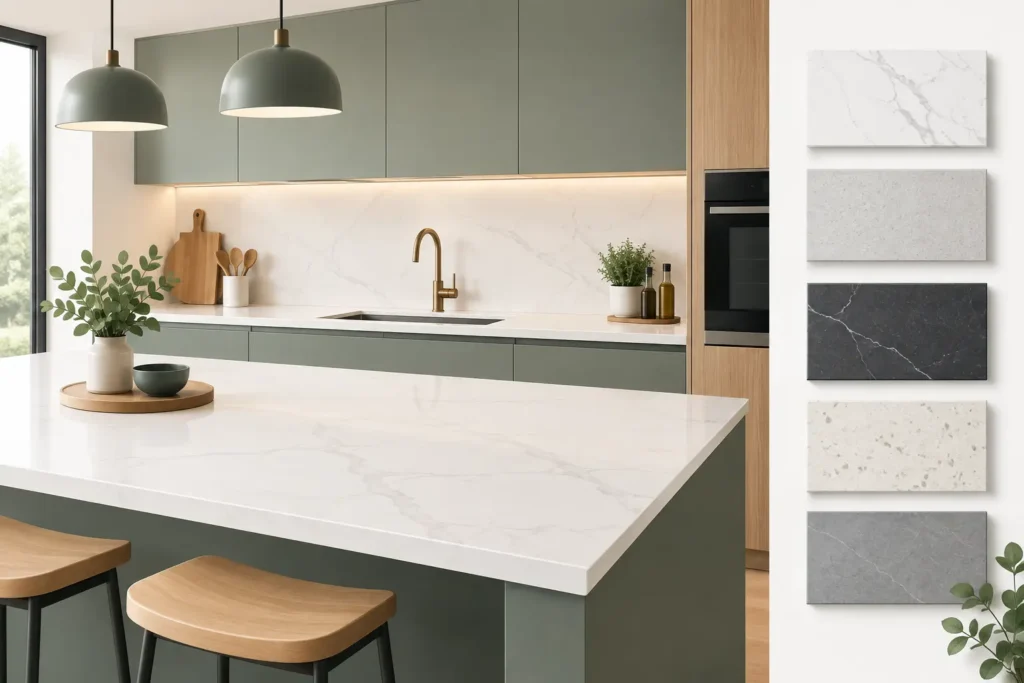
A worktop has to cope with far more than it is often given credit for. It is where breakfasts are made, homework is spread out, pans are set down and guests tend to gather. Quartz worktops are a popular choice for homeowners who want a refined kitchen surface that can stand up to busy everyday life without demanding excessive maintenance.
Their clean, consistent appearance suits a wide range of kitchen styles, from understated Shaker cabinetry to crisp contemporary furniture. Yet quartz is not a one-size-fits-all decision. The best result depends on the colour, thickness, edge detail, layout and, crucially, the quality of the measuring and fitting.
What are quartz worktops made from?
Quartz worktops are engineered stone surfaces. They are typically made from natural quartz particles combined with resins and pigments, then formed into dense slabs. This gives the material the visual depth associated with stone while allowing for a more controlled range of colours and patterns than many natural materials.
The exact make-up varies by manufacturer, so samples matter. A pale surface may be a soft, warm white in one range and a sharper, cooler white in another. Some designs have delicate veining that resembles marble, while others are almost plain, with a fine grain or sparkle. Seeing a full sample beside your cabinet door, flooring and wall colour is far more useful than choosing from a small image online.
Quartz is non-porous, which is one of its principal advantages in a family kitchen. Unlike some natural stone, it does not usually need regular sealing. Spills are less likely to soak in, making the surface straightforward to keep looking its best.
Why quartz worktops work so well in busy kitchens
For many homes, the appeal is a balance of appearance and practicality. Quartz has a solid, substantial feel and can create an uninterrupted surface across long runs, islands and peninsulas. It is available in colours that work with almost any cabinet finish, including warm neutrals, dramatic dark tones and marble-inspired whites.
Daily care is simple. A soft cloth, warm water and a mild detergent will deal with most marks. There are no grout lines to clean around a standard upstand or splashback, and the non-porous finish is well suited to food preparation areas when cared for correctly.
It is also a dependable choice where a kitchen needs to look composed rather than overly precious. A lightly patterned quartz can disguise the odd crumb or water mark better than a very plain polished white surface, while a subtle veining pattern can introduce character without making the room feel busy.
That said, durability is not the same as indestructibility. Quartz is highly resistant to staining and everyday scratching, but it should still be treated as a quality finish. Use a chopping board rather than cutting directly on it, and avoid dragging rough ceramic or metal objects across the surface. Its hard-wearing nature makes it forgiving, not invulnerable.
Choosing quartz worktops that suit your room
The right quartz should support the overall design rather than compete with it. In a compact kitchen, a pale worktop can help bounce light around the room, particularly when paired with lighter cabinetry. If you prefer darker units, a softly veined white or light grey quartz can provide contrast without appearing stark.
In a larger kitchen, an island offers the chance to be more expressive. A bolder stone-look pattern can make it a focal point, especially if the perimeter worktops are quieter. The aim is not to match every colour exactly, but to create a considered relationship between the cabinetry, worktop, handles, flooring and lighting.
Colour and pattern
Plain quartz has a calm, modern quality and works particularly well where the cabinets include texture, timber grain or a detailed painted finish. Marble-effect quartz offers a more decorative look but needs careful planning. Veins should flow naturally across joins and through any upstand or splashback where possible.
Consider the room’s orientation too. North-facing kitchens often benefit from warmer whites and soft beige-grey tones, whereas a bright south-facing space can comfortably take cooler shades. Under-cabinet lighting and pendant lights can alter how a surface reads at different times of day, so it is sensible to view samples in your own home.
Thickness, edges and details
A 20mm worktop is a popular contemporary choice, with a clean, slim profile. A 30mm option can feel more traditional or substantial, particularly alongside classic cabinetry. It is also possible to create a deeper-looking edge by building up the front of the worktop, giving an island a stronger furniture-like presence without using a solid slab at that full thickness.
Straight polished edges are timeless and easy to live with. A small chamfer or pencil-round softens the feel of the surface and can be a good choice for households with young children. More decorative profiles may suit a period-style kitchen, but they should be chosen with cleaning and the wider design in mind.
Upstands, full-height splashbacks and window sills can all be made in matching quartz. A full-height splashback behind a hob creates a particularly smart finish, although the final arrangement needs to account for sockets, extractor requirements and the chosen cooking appliance.
Good planning makes the finished worktop feel effortless
Stone worktops are normally templated once the base cabinets are installed, levelled and fixed in their final positions. This is the stage where accuracy matters. Walls are not always straight, corners are not always square and older properties can present plenty of surprises. A professional template allows the worktop to be made for the room as it actually is, rather than as a drawing suggests it should be.
Sink and hob cut-outs, tap holes, drainer grooves, breakfast bars and overhangs should be agreed early. An undermounted sink produces a clean, uninterrupted line and makes wiping crumbs into the bowl easier, but it requires the right sink specification and careful installation. A Belfast-style sink brings a different character and may influence the worktop layout around it.
If you are planning a breakfast bar, discuss support from the outset. Quartz is heavy, and substantial overhangs need appropriate brackets or discreet structural support. This is not an area for assumptions, particularly where children may lean or sit on the extended section.
At Hale & Murray, the design process considers these practical details alongside the cabinetry itself. A made-to-measure kitchen benefits when furniture, appliances and worktop are planned as one project, rather than treated as separate decisions made at the last minute.
Heat, sunlight and everyday care
Quartz is heat resistant, but it is not designed for direct contact with very hot cookware. Always use a trivet or heatproof mat for pans, roasting tins and slow cookers. Sudden or concentrated heat can damage the resin content and may leave marks that cannot be polished away.
Likewise, avoid harsh oven cleaners, paint strippers, strong bleach and abrasive scouring pads. These products can dull the finish or affect the surface over time. If a stubborn mark occurs, use a cleaner recommended for engineered stone and follow the manufacturer’s guidance.
In rooms with strong, prolonged sunlight, it is worth checking the chosen product’s suitability with your supplier. Most kitchens will be perfectly straightforward, but expansive glazing, conservatory-style extensions and direct UV exposure may affect the choice of surface or colour.
When quartz may not be the best choice
Quartz is an excellent all-rounder, but every material has trade-offs. If you want a surface that develops a natural patina and can be refreshed or repaired in a more traditional way, timber may be more appealing. If you want exceptional resistance to heat for serious cooking, certain sintered stone or porcelain surfaces may deserve consideration.
Natural granite offers unique variation, while marble brings a distinctive beauty that comes with a greater need for care. Budget also plays a part: worktop costs depend not only on the chosen slab but on the number of cut-outs, joins, edge treatments, splashbacks and the complexity of installation.
The most suitable choice is therefore the one that fits your household habits as well as your design preferences. A beautiful worktop should make daily life easier, not make you worry every time someone puts down a mug.
Before making a final selection, take samples home, place them in the intended light and think through how you genuinely use your kitchen. A well-chosen quartz surface will not simply finish the room – it will give the whole space a dependable foundation for the years ahead.