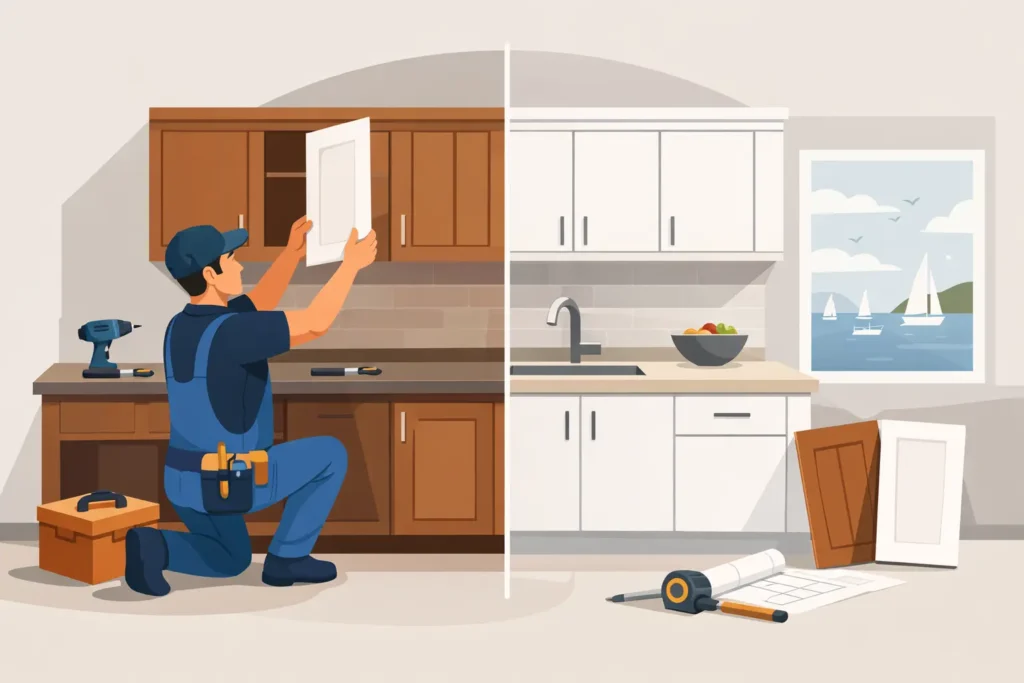
A kitchen can feel dated long before its cabinets have reached the end of their working life. If the units remain sound, a kitchen door replacement service can give the room a considered new look without the disruption, cost and waste of removing everything and starting again.
For homeowners in Poole, Bournemouth and across Dorset, this is often the sensible middle ground between a cosmetic touch-up and a complete kitchen renovation. New doors, drawer fronts, handles and, where needed, worktops can change the character of the space while retaining the storage and layout that already work for your household.
When replacement doors are the right choice
Kitchen door replacement is best suited to cabinets with structurally sound carcasses. Open a few doors and drawers, look inside the units and check the fixing points. If the cabinets are stable, free from serious water damage and still meet your storage needs, there may be no practical reason to replace them.
The main benefit is that you can focus investment where it is most visible. Doors and drawer fronts carry the colour, style and finish of a kitchen. Replacing them can take a room from tired gloss to a warmer painted look, from traditional shaker styling to a cleaner contemporary design, or simply from worn handles and chipped edges to a finish that feels properly looked after.
It does depend on the condition and arrangement of the existing kitchen. A replacement-door project will not solve poorly planned storage, damaged cabinets, awkward appliance positions or a lack of worktop space. In those cases, a full redesign may offer better long-term value. A careful home visit helps establish which route makes sense before any decisions are made.
What a kitchen door replacement service should include
A good result is not just a matter of choosing an appealing door. Replacement doors need to fit accurately, align neatly and work with the dimensions, hinge positions and opening requirements of your existing units. Small variations can be very noticeable across a run of cabinets.
The process should begin with a proper assessment and precise measuring. This identifies the number and size of doors, drawer fronts, end panels, plinths and any special pieces required around appliances, corner units or tall cabinets. It is also the time to discuss whether existing hinges can be retained or whether new hinges, soft-close fittings or handles would improve day-to-day use.
From there, the design choices can be brought together. Colour, door profile, handle style, worktop material and splashback finish all need to sit comfortably with the flooring, wall colour and light in the room. Samples are particularly useful because a shade that looks right in a showroom can appear quite different in a north-facing kitchen or under warm evening lighting.
At Hale & Murray, replacement doors are made to order in our own workshop, rather than selected from a limited range of standard sizes. That gives more flexibility for kitchens with non-standard cabinets and allows the finer details to be considered properly, including matching panels and finishes that create a more complete result.
Choosing a style that will still feel right in years to come
The most successful replacement projects respect both the house and the way the kitchen is used. A family kitchen that works hard every day may suit a durable, easy-clean finish and practical handles. A period property might call for a framed door with a quieter painted colour. For a compact kitchen, lighter tones and less visual clutter can help the room feel more open.
Shaker doors remain popular because they work across traditional and contemporary homes, but they are not the only dependable choice. Flat slab doors create a simple, modern appearance, while handleless styles can give a streamlined effect where clean lines are the priority. Textured woodgrain finishes introduce warmth without the maintenance considerations of some natural timber finishes.
Colour deserves more thought than simply following a current trend. Deep greens, blues and charcoal tones can be striking, particularly on a larger kitchen with good natural light. In a smaller or darker room, soft neutrals, warm whites and pale greys are often easier to live with. A two-tone approach can also work well, such as darker base units with lighter wall cabinets, provided the contrast supports the room rather than making it feel busy.
Do not overlook worktops, panels and hardware
Replacing only the doors can make a substantial difference, but sometimes the surrounding components show their age more clearly once the new fronts are in place. Worn plinths, mismatched end panels and dated handles can interrupt an otherwise fresh design.
A new worktop can be particularly worthwhile if the existing surface is scratched, swollen around the sink or difficult to keep clean. It also gives an opportunity to alter the overall look, whether that means a practical laminate, a warm wood-effect surface or a more substantial stone-style finish. If the worktop is being changed, it is sensible to check the condition of the sink, taps and splashback at the same time, as these elements are closely connected.
Hardware is a modest part of the budget but has a significant effect on how the kitchen feels. Knobs, bar handles, cup pulls and integrated handle profiles each create a different impression. The right choice should be comfortable to use as well as attractive. Soft-close hinges and drawer runners can also improve the everyday experience, especially where existing fittings have become loose or noisy.
Measuring and fitting make the difference
It is tempting to view replacement doors as a straightforward supply-and-fit job. In reality, accurate measuring and skilled installation are what prevent common frustrations such as uneven gaps, catching doors, misaligned handles and exposed cabinet edges.
Older kitchens can present particular challenges. Cabinet dimensions may vary slightly from one unit to the next, walls may not be perfectly straight and previous alterations can affect how panels and worktops meet. Bespoke manufacture provides useful flexibility, but it must be supported by detailed planning and a fitter who takes the time to adjust and align every component.
A managed service also reduces the number of separate decisions for the homeowner. If worktops, plumbing changes, tiling or minor building work are part of the project, coordinating the sequence matters. Removing a worktop before a replacement is ready, for example, can leave a kitchen out of action unnecessarily. Planning the work in the right order keeps disruption to a minimum.
Cost, value and the questions worth asking
The cost of replacing kitchen doors varies with the number of units, door style, finish, hardware and whether worktops or other elements are included. It is usually less expensive than a complete new kitchen because the cabinet carcasses and much of the existing layout remain in place. However, the cheapest option is not always the best value if doors are poorly sized, have limited finish choices or are fitted without sufficient care.
Before committing, ask what is included in the quotation. It should be clear whether measuring, removal of old doors, new hinges, handles, panels, fitting and disposal are covered. If you are considering a supply-only option, confirm that the door sizes, hinge drilling and edge details are specified correctly for your cabinets. This route can suit capable DIY homeowners and trade customers, but accurate information is essential.
It is also worth asking how replacement parts will be handled in future. Kitchens are used every day, and accidents happen. A local manufacturer that can make matching components offers reassurance if a door or panel needs replacing later on.
A considered refresh for a kitchen that still works
A replacement-door project is not about disguising a poor kitchen. It is about recognising when the foundations are good and making them work harder for the next chapter of your home. With well-made doors, careful measurements and fitting that respects the existing room, the result can feel far more substantial than a simple update.
If you are weighing up a kitchen door replacement service, bring a few photographs and rough dimensions to a design consultation, or arrange a home visit. Seeing the cabinetry in place is the best way to decide whether fresh doors are the right investment and to shape a finish you will be pleased to come home to for years.