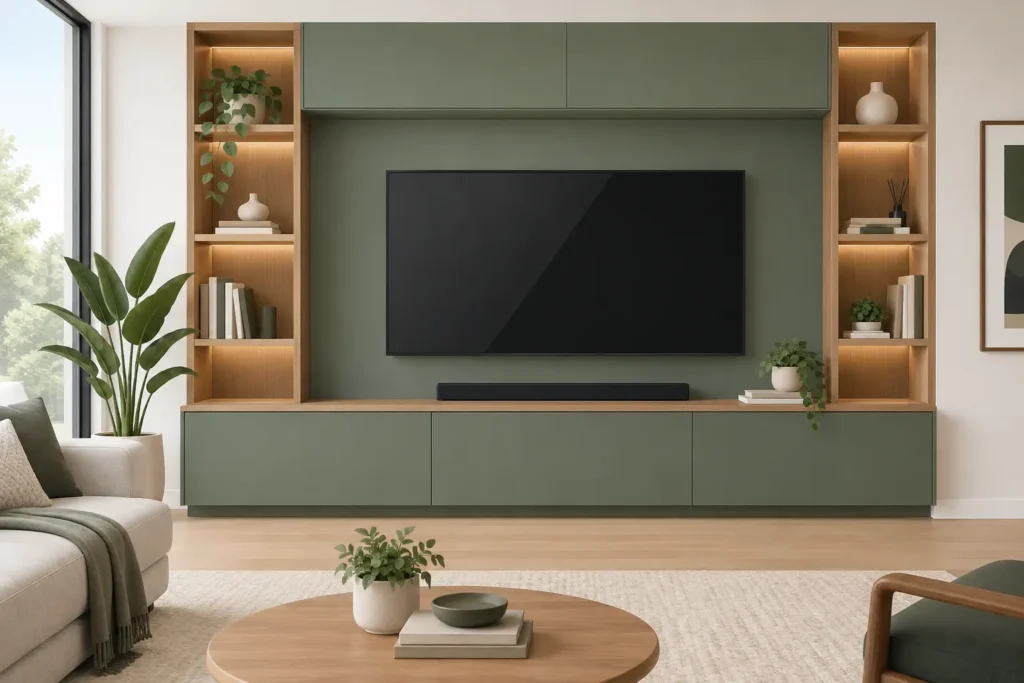
A television is often the focal point of a lounge, yet the equipment around it can quickly make the room feel untidy. Cables, consoles, speakers, remotes and piles of everyday items all need a home. Made to measure media furniture turns that awkward collection into a considered part of the room, with storage, display space and proportions designed specifically for your home.
For homeowners in Poole, Bournemouth and across Dorset, fitted media furniture is increasingly chosen as an alternative to a freestanding TV unit or a one-size-fits-all media wall. It can make practical use of an alcove, span an entire wall or create a calm, balanced feature in an open-plan living space. The right design is not simply about hiding the television. It should support how you relax, entertain and use the room every day.
Why choose made to measure media furniture?
A ready-made cabinet may suit a straightforward room, but it rarely accounts for uneven walls, chimney breasts, alcoves, skirting boards or the exact position of sockets. Bespoke furniture is measured for the available space, so it can sit neatly wall to wall, floor to ceiling or within a difficult recess without wasted gaps at either side.
That precision also changes what the furniture can hold. Some households need deep cupboards for games consoles and audio equipment. Others prefer shallow display shelving for books, photographs and carefully chosen objects. A family room may need closed storage for toys and chargers, while a quieter sitting room might call for a more restrained arrangement with a low cabinet and painted shelving.
The benefit is a room that works harder without looking harder. Instead of adding several separate pieces of furniture, a fitted design brings the television, storage and decorative elements together in one planned composition.
Start with the room, not the screen
It is tempting to begin with the size of the television, but the room should lead the design. A very large screen on a narrow wall can dominate the space, while a small television surrounded by oversized cabinetry may look lost. Viewing distance, seating position, natural light and the height of the screen all deserve consideration before the furniture is drawn.
A good starting point is to think about what you see from the sofa. If the television is wall-mounted, the centre of the screen should normally sit at a comfortable eye level when seated. The cabinet beneath should allow enough clearance for a soundbar, if required, without pushing the screen too high. In rooms used by children as well as adults, practical access to controls and safely managed cables may carry more weight than a minimalist look.
The wall itself matters too. A chimney breast can provide a natural centre point, but the space on either side may be more valuable than the breast. In some homes, symmetrical cabinets and shelving create a classic built-in appearance. In others, an asymmetrical arrangement feels lighter and gives better access to a nearby door, radiator or window.
Consider the equipment you use now and later
Media furniture should be planned around the equipment you own, but leave sensible flexibility for what may change. Television sizes, streaming devices and speaker systems evolve. Adjustable shelving, removable rear access panels and adequately sized cable routes make future changes less disruptive.
Ventilation is particularly important for enclosed equipment. Games consoles, amplifiers and satellite boxes generate heat, so a cupboard needs suitable airflow rather than a completely sealed box. This can be handled discreetly through vented panels, open-backed sections or carefully positioned gaps that do not compromise the finished appearance.
It is also worth deciding which items need to remain visible. A soundbar may need an open shelf for performance, while routers, extension leads and charging accessories are usually better concealed. Small choices at the design stage prevent the familiar tangle of wires returning a few weeks after installation.
Storage that keeps the lounge calmer
The most successful media furniture has a clear purpose for every section. Lower cupboards are useful for the items that create visual clutter, including controllers, board games, spare blankets and children’s toys. Drawers can be a practical choice for smaller accessories, while taller side units may accommodate books, files or a compact home-working area.
Open shelving has its place, but it needs proportion. Too many narrow shelves can make a room feel busy, particularly around a large black screen. Wider, well-spaced shelves tend to look more composed and are easier to style. Combining a small amount of open display space with closed storage often gives the most adaptable result.
For compact lounges, a fitted unit can also replace other furniture. A low run of cabinetry may provide a generous surface for lamps and personal items while freeing the floor from extra sideboards. In a larger room, a full-height feature wall can help the television feel intentional rather than floating on an otherwise empty expanse.
Choosing a style that belongs in your home
Media furniture should complement the age and character of the property, as well as the rest of the interior. Traditional homes may suit framed doors, painted finishes and a more furniture-like profile. Contemporary spaces often work well with clean slab doors, shadow gaps and simple shelving, although there is no need for every design to be stark or uniform.
Colour has a useful role beyond decoration. A darker backdrop behind the television can reduce the visual contrast of the screen when it is switched off. Matching the cabinetry to existing walls creates a quieter, more architectural effect. Alternatively, a contrasting painted finish can turn the unit into a deliberate focal point.
Material choices should reflect daily use. Durable painted finishes suit many living spaces and can be refreshed over time. Timber textures add warmth, especially when paired with softer furnishings, while glass-fronted sections can protect treasured items without hiding them entirely. Handles, lighting and internal finishes may seem like secondary details, but they shape how the furniture feels to use.
Lighting should support, not compete
Integrated lighting can give a media unit depth after dark, particularly in shelves and display niches. Warm, subtle lighting is generally more comfortable in a lounge than bright, cool strips. It should help you find what you need and create atmosphere, not reflect on the screen or draw attention to every object on display.
Planning lighting alongside the furniture also avoids surface-mounted cables and last-minute compromises. Depending on the scheme, switches, dimmers and electrical work can be coordinated before installation so that the finished room remains tidy and practical.
What a properly planned installation involves
A fitted media project may look simple once complete, but the quality of preparation is visible in the result. Accurate measuring is essential, particularly in older properties where walls and floors are seldom perfectly straight. The design also needs to account for radiator pipes, plug sockets, aerial points, access panels and any building work required before fitting.
This is where a full-service approach can remove much of the uncertainty. At Hale & Murray, the process can begin with a free design consultation and home visit, allowing the proposed furniture to respond to the room rather than relying on standard sizes. Furniture is made in-house, with the design, manufacture and installation managed as one project.
Where a scheme needs more than cabinetry, coordinating the relevant trades is equally valuable. Electrical alterations, wall preparation, plastering or decorating may be needed before the furniture is fitted. Addressing these requirements early helps protect the finish and reduces the chance of delays when installation day arrives.
There is a trade-off to acknowledge. Made-to-measure furniture is a considered investment and usually costs more than buying a cabinet from a high-street retailer. It also requires decisions on layout, finishes and equipment before manufacture begins. In return, you receive a design built for the room, greater control over storage and a result intended to remain useful as your home changes.
Getting the brief right before you begin
Before a design appointment, take note of the wall dimensions, the size of your current television and the equipment you need to accommodate. Photograph the room from several angles and consider what currently frustrates you. It may be visible cables, a shortage of storage, an unused alcove or the fact that the television has no natural place to sit.
Think, too, about the feeling you want from the room. Do you want the screen to disappear into a calm run of cabinetry when not in use, or should the television form part of a striking feature wall? Both approaches can work beautifully, but they lead to very different designs.
The best made to measure media furniture does not ask you to change the way you live to suit it. It gives everyday items a sensible home, respects the proportions of the room and makes settling down at the end of the day feel simpler. A conversation with an experienced designer is often the most useful first step towards a lounge that looks as considered as the rest of your home.