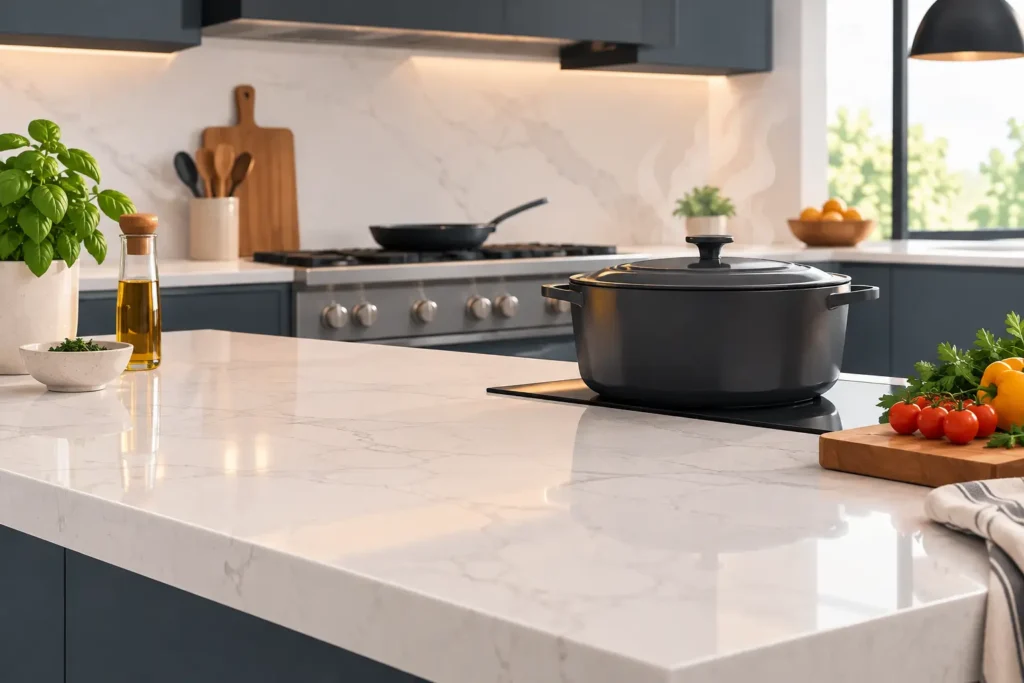
A worktop has to cope with far more than its appearance suggests. It is where pans are set down, roasting trays are unloaded and hot drinks are made during the morning rush. Quartz heat resistance is therefore a sensible question for anyone choosing a new kitchen worktop. Quartz is highly durable for daily family life, but it is not indestructible when exposed to direct, intense heat.
The key is understanding what quartz is made from, where the risk lies and how a well-planned kitchen can make caring for the surface straightforward. For many homes in Poole, Bournemouth and across Dorset, quartz remains an excellent choice – provided it is used with the care recommended for an engineered stone surface.
What does quartz heat resistance really mean?
Kitchen quartz is an engineered material. It is made largely from natural quartz particles, combined with pigments and binding resins, then formed into a dense, practical worktop. This construction gives it a hard, non-porous surface that stands up very well to everyday use, including spills, food preparation and general knocks.
However, the resin content is also why direct heat needs attention. A pan lifted straight from the hob, a hot casserole dish from the oven or a heated appliance placed in one spot can expose the surface to sudden, concentrated heat. In some circumstances, this may cause discolouration, a dull patch, cracking or damage to the resin bond.
There is no single temperature that applies to every quartz brand, thickness or finish. Manufacturers set their own guidance, and the way heat is applied matters as much as the heat itself. A warm plate placed briefly on a worktop is not the same as a cast-iron pan fresh from a high oven.
Why sudden heat is the bigger concern
Quartz performs well in a normal kitchen environment, but rapid temperature changes can place stress on the surface. This is often described as thermal shock. The worktop may be at room temperature, then receive intense heat in a very small area. That difference can be more problematic than gradual warmth spread over a larger surface.
The areas most likely to be affected are beside the hob, near an oven, around an Aga or range cooker, and beside a boiling-water tap. Steam from a dishwasher can also be relevant if it repeatedly escapes on to an unprotected worktop edge. These are not reasons to avoid quartz, but they are details that should shape the design and everyday use of the room.
A good kitchen design anticipates real habits. If you regularly drain pans beside the hob or unload baking trays in the same place, make room for a heat-resistant trivet or a dedicated landing area. It is a small practical decision that helps protect a worktop chosen to last for years.
Can you put hot pans on a quartz worktop?
It is best not to place hot pans, oven trays, slow cookers or other heat-generating cookware directly on quartz. Use a trivet, pan stand or wooden board with suitable heat protection instead. This should be treated as normal worktop care, rather than an inconvenience.
Some homeowners assume that a stone-look surface can be treated exactly like natural stone. That is not always the case. Quartz is different from granite, and it is very different from quartzite, which is a natural stone. While both can look refined and substantial in a kitchen, they have different compositions, care requirements and responses to heat.
The practical rule is simple: if an item would be uncomfortable to touch, do not put it straight on the worktop. Give it a protected place to rest. This is particularly worthwhile with heavy cookware, where both heat and impact can affect the surface.
Everyday items that deserve extra care
Not every warm item presents the same risk. A mug of tea, a dinner plate or a bowl of freshly cooked food will rarely create an issue in normal use. The concern is concentrated, sustained heat.
Take particular care with pans from the hob, roasting tins from the oven, worktop grills, air fryers, portable induction units and slow cookers. Appliances that release heat or steam underneath need clearance and should not be left running directly on the quartz unless the manufacturer confirms they are suitable for that use.
If you use a coffee machine or toaster in the same position every day, it is worth checking that heat and moisture are not building up underneath. A sensible layout, good ventilation and a suitable protective mat can prevent avoidable marks over time.
How to protect quartz worktops from heat
The best protection is built into daily routines and the kitchen layout. Keep trivets close to the oven and hob, rather than stored at the back of a cupboard. A small heatproof zone beside the cooker is much more likely to be used when everyone is preparing supper.
Consider the worktop edges as carefully as the main surface. Where a dishwasher sits beneath quartz, correct fitting and appropriate protection are essential, as repeated steam exposure can affect adjoining materials and joints. The same principle applies around sinks and boiling-water taps, where heat and moisture often occur together.
For families who cook frequently, an integrated wooden chopping board, a stainless-steel preparation area or a carefully positioned ceramic trivet can make the kitchen more forgiving without compromising the overall design. The right option depends on how you use the room, not simply on the latest kitchen trend.
At Hale & Murray, this is the sort of practical detail considered during a free design consultation. A bespoke kitchen should look right on installation day, but it should also support the way you cook, entertain and live in it afterwards.
What to do if heat marks or damage appear
A faint mark is not always permanent heat damage. It may be residue from cookware, a surface deposit or a change in light across the finish. Start gently: clean the area with warm water, a soft cloth and a mild cleaner suitable for quartz, then dry it thoroughly.
Avoid abrasive pads, harsh oven cleaners, strong chemicals and attempts to sand or polish the worktop yourself. These can make a small problem more noticeable by changing the sheen or scratching the surrounding surface.
If the area remains discoloured, feels uneven or shows a crack, seek professional advice before trying any repair product. Whether a repair is possible depends on the colour, pattern, extent of the damage and the worktop construction. A local specialist can assess whether a discreet repair, a replacement section or a new worktop is the most sensible route.
Is quartz still a good choice for kitchens?
For many households, yes. Quartz offers a smart balance of appearance, consistency and low-maintenance daily care. Its non-porous nature makes it particularly appealing for busy kitchens, where spills and food preparation are part of every day. Unlike some natural stones, it does not usually require regular sealing.
The trade-off is that quartz needs protection from direct high heat. If you want to place hot pans anywhere without a trivet, a different material may suit your cooking style better. Granite, porcelain and certain natural stones each have their own strengths, limitations and fitting considerations, so the right decision should be based on your priorities rather than a single performance claim.
Colour and finish matter too. A pale, polished quartz may show a change in sheen differently from a darker, textured surface. Veined designs can disguise everyday marks well, while a plain colour can create a more minimal look but may make damage easier to spot. Seeing full samples in person is valuable, particularly in the light of your own home.
Choosing a worktop with confidence
A worktop is not an isolated purchase. Its performance depends on material choice, accurate templating, careful installation and the way it works alongside appliances, cabinetry and your household routine. Ask clear questions about heat guidance before choosing a surface, especially if you love cooking with cast iron, batch-bake regularly or rely on worktop appliances.
Quartz can give a kitchen a beautifully composed, hard-wearing finish, and sensible heat protection is a modest part of looking after it. When the material and layout are chosen around the way you really use your kitchen, the result is easier to enjoy every day.