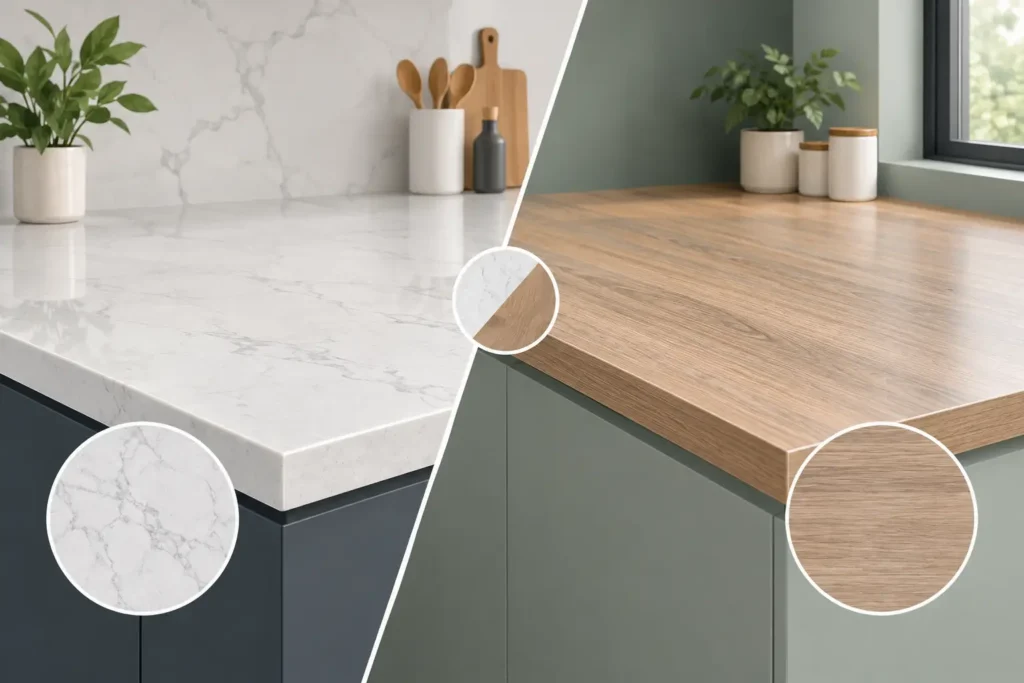
A worktop has to cope with far more than it gets credit for: hot pans set down in a hurry, school bags dropped after the morning rush, wine opened when friends arrive and years of daily cleaning. When weighing up quartz versus laminate, the best choice is rarely just about which sample looks smartest under showroom lighting. It is about how your kitchen is used, how long you expect it to last and where you would prefer to invest your budget.
Both materials can create an attractive, practical kitchen. Quartz brings weight, depth and long-term durability, while modern laminate offers a remarkably broad range of looks at a more accessible price. Understanding the differences before your kitchen is designed will help you make a choice you remain happy with long after installation day.
Quartz versus laminate: the essential difference
Quartz worktops are engineered stone. They are made from natural quartz particles combined with resins and pigments, then formed into dense slabs. The result is a solid, substantial surface available in everything from quiet pale stone effects to dramatic veining and darker contemporary finishes.
Laminate worktops are built differently. A decorative printed layer is bonded to a board core and protected by a hard, durable surface layer. The quality and realism of laminate designs have improved considerably, with convincing stone, marble, concrete, timber and plain matt options available.
The fundamental difference is depth. Quartz is solid material through the thickness of the slab. Laminate is a layered worktop with a decorative face. That does not make laminate a poor choice, but it does affect how each material wears, how it can be repaired and how it should be treated.
Durability in a busy home
Quartz is a strong option for households that want a worktop to take plenty of daily use. Its non-porous surface is highly resistant to staining from common kitchen spills such as coffee, oil and red wine, and it does not normally need sealing. It is also more resistant to scratches than laminate, although no worktop is completely scratch-proof. Chopping directly on any worktop is best avoided.
Laminate is durable for normal family use, but it needs a little more care around edges, joins and heat. Its protective surface handles everyday wiping and food preparation well. However, standing water left near a poorly protected joint can eventually affect the board beneath, and a deep scratch or chip cannot usually be polished out in the way minor marks on quartz sometimes can.
Heat is another practical dividing line. Quartz tolerates heat better than laminate, but it is still sensible to use trivets for hot pans and oven dishes. Sudden, intense heat can damage the resin content within quartz. Laminate is more vulnerable to scorching and should never be used as a resting place for cookware straight from the hob or oven.
For a hard-working kitchen used by a large family or keen cooks, quartz often gives greater reassurance. For a utility room, rental property, first renovation or kitchen with a carefully managed budget, laminate can provide excellent service when specified and fitted properly.
Appearance and design flexibility
Quartz has a tactile quality that many homeowners value. It reflects light differently from a printed surface, and the material has a visual depth that works particularly well in bespoke kitchens. A softly veined quartz can bring character to painted cabinetry, while a simple white, grey or dark slab can give a more architectural finish.
It is also possible to use quartz for upstands, splashbacks, window sills and a matching island, creating a considered, continuous look. The slab size, pattern direction and placement of joins should be planned as part of the design. On heavily veined designs especially, careful fabrication makes a visible difference.
Laminate has a different strength: choice. It can deliver the appearance of materials that may otherwise be outside the budget, including marble-effect and timber-effect finishes, without demanding the same investment. Textured matt laminates and square-edged profiles have helped move the material well beyond the basic worktops many people remember.
A laminate worktop can look exceptionally good when paired with the right doors, handles, wall finishes and lighting. It is particularly useful where you would rather allocate more of the overall spend to storage, appliances, lighting or tailored cabinetry. The key is to view a full-sized sample where possible, not just a small chip, as scale and texture influence the finished effect.
Cost: look beyond the initial price
Laminate is typically the lower-cost option, both for material and installation. This can make a real difference across a larger kitchen, particularly where long runs, a peninsula or island are involved. It also allows a homeowner to achieve a fresh, coordinated result without compromising on the layout or practical features that make a kitchen easier to live with.
Quartz costs more because of the material itself, templating, specialist cutting, fabrication and installation. It is heavy and requires experienced handling. Sink and hob cut-outs, drainer grooves, upstands and shaped edges all add to the final price.
That said, value is not simply the lowest upfront figure. A quartz worktop may suit a long-term home where durability and a premium finish are priorities. Laminate may be better value where the kitchen will be updated again sooner, where the property is being prepared for sale, or where a high-quality look is needed while keeping funds available for other work.
Ask for a clear quotation that explains what is included. For quartz, this should cover templating, fitting, cut-outs, edge details, upstands and any removal of existing worktops. For laminate, check the thickness, edge profile, joint method and whether sink and hob cut-outs are included. Like-for-like comparisons are the only fair way to judge cost.
Cleaning and day-to-day care
Quartz is straightforward to maintain. A soft cloth, warm water and mild detergent are normally enough for everyday cleaning. Avoid harsh oven cleaners, strong bleach left on the surface and abrasive scourers. Wipe spills promptly, especially products with strong dyes or acids.
Laminate is equally easy to clean in daily use with a damp cloth and mild detergent. Its main requirement is sensible moisture management. Do not leave standing water along joints or around the sink, and dry splashes from the edges. Avoid cutting directly on the surface and use a heatproof mat for hot items.
Neither choice needs complicated routines. The difference is that quartz gives more tolerance for the occasional lapse, while laminate rewards steady care at the areas most exposed to heat and water.
Installation matters as much as the material
A well-made worktop can be let down by poor measuring or rushed fitting. With quartz, accurate templating after cabinets are installed and levelled is essential. Walls are not always straight, floors can vary and larger pieces need planning to ensure safe access and sensible joins.
With laminate, the fitting details are just as important. Neat joints, properly sealed cut-outs and careful treatment around the sink protect the worktop and improve its appearance. A worktop should be selected alongside the cabinetry, rather than as an afterthought, so overhangs, appliance clearances, splashbacks and end panels all work together.
This is where a full kitchen design service can remove uncertainty. At Hale & Murray, worktops are considered as part of the complete room, with the cabinetry, appliances and installation details planned around how the household lives.
Which worktop is right for your kitchen?
Choose quartz if you are investing in a long-term kitchen, want a solid and refined finish, and would value strong resistance to stains and everyday wear. It is particularly well suited to statement islands, open-plan spaces and kitchens where the worktop is a major visual feature.
Choose laminate if you want a practical, attractive surface at a lower price point, or if spending more on made-to-measure storage, appliances or building work will improve the room more. It is also a sensible choice for utility rooms, secondary kitchens and projects where design flexibility matters most.
There is no universal winner in quartz versus laminate. The right surface is the one that suits your household, your design and the life you expect from the room. Bring home samples, place them beside your door and flooring choices, and consider how they will look in your own daylight. A worktop should feel right not only on day one, but on an ordinary Tuesday evening years from now.