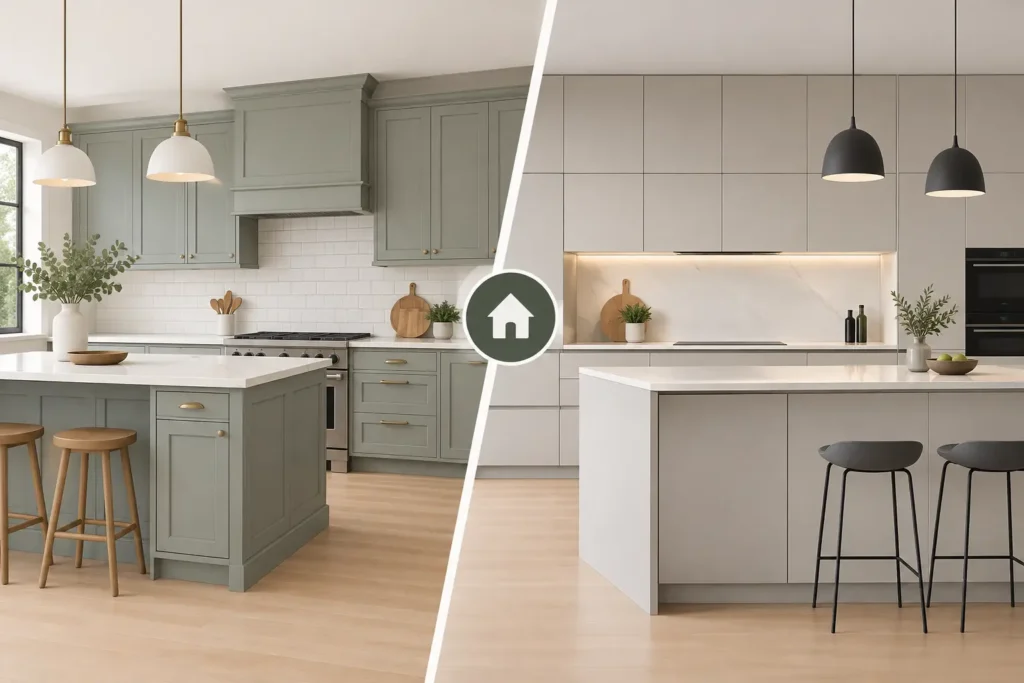
A kitchen can look completely different before a worktop or tap has been chosen. The decision between shaker versus handleless sets the character of the room: one has detail, warmth and familiarity; the other is pared back, architectural and calm. Neither is automatically the better choice. The right answer depends on your home, how you use the space and what you want to enjoy seeing every day.
For homeowners planning a lasting renovation in Poole, Bournemouth or the wider Dorset area, it is worth looking beyond current fashions. A well-designed fitted kitchen should work hard, sit comfortably within the property and still feel right years after installation.
What defines a shaker kitchen?
Shaker doors have a framed construction, with a recessed centre panel and a simple, symmetrical profile. The design originates from practical furniture-making traditions, which is why it has remained so popular. It brings detail without excessive ornament, making it equally at home in a period cottage, a Victorian terrace or a newer family property.
Its flexibility is a major strength. A shaker kitchen can feel traditional with painted timber tones, cup handles and a Belfast sink, or more contemporary with slim bar handles, a smooth quartz worktop and a restrained palette. Soft sage, warm grey, stone and deep blue all work well, but a bespoke kitchen is not restricted to a handful of standard finishes.
The visible frame gives shaker cabinetry presence. In a large open-plan room, that detail can help the kitchen feel settled rather than flat. In a smaller space, slimmer rails and a lighter colour scheme can retain the character without making the room feel busy.
Where shaker works particularly well
Shaker cabinetry often suits homes where the kitchen needs to feel welcoming as well as functional. It works especially well alongside natural wood, stone-effect surfaces, aged brass or brushed nickel hardware, and practical features such as larder cupboards and dresser-style storage.
It is also a sensible choice for households that want a timeless look without making the room feel overly formal. The door style has enough character to stand on its own, while leaving plenty of scope to update wall colours, handles, lighting and accessories later.
What defines a handleless kitchen?
A handleless kitchen has clean, uninterrupted cabinet fronts. Doors and drawers are opened using an integrated rail, a recessed channel, a finger pull or push-to-open hardware. The result is a crisp, linear appearance that is particularly effective in contemporary homes and open-plan extensions.
Without handles projecting from the cabinetry, the room can appear wider and calmer. This is valuable where kitchen units run along a long wall, wrap around an island or sit within a compact flat-style layout. Handleless furniture can also coordinate naturally with fitted utility rooms, home offices and living-room cabinetry, creating a more considered whole-home scheme.
A handleless design does not have to mean high-gloss white. Matt finishes, wood grains, textured decors and rich darker colours can all bring warmth. A carefully chosen worktop, splashback and lighting scheme prevent the room from feeling clinical.
Where handleless works particularly well
Handleless kitchens are often chosen for modern extensions, new-build homes and spaces with strong architectural lines. They are ideal when an island is intended to look more like a piece of furniture than a bank of cupboards, or when clients want appliances and storage to recede into the background.
They can also be practical in narrow walkways. With no handles extending into the room, there is less to catch on as people move around the kitchen. For busy family kitchens, however, it is worth considering how easy the opening system feels for every member of the household before making a final choice.
Shaker versus handleless: the practical differences
Style is only one part of the decision. Day-to-day use matters just as much, particularly when investing in a made-to-measure kitchen.
Cleaning and maintenance
Shaker doors have edges and recessed panels that naturally collect a little more dust or cooking residue than a completely flat front. They are straightforward to clean, but need a wipe around the frame rather than a quick pass over one smooth surface. A high-quality painted or durable finished door should stand up well to normal family life, provided spills are dealt with promptly.
Handleless doors are simpler in shape, but the opening channel needs attention. Crumbs and dust can collect in recessed rails, while push-to-open doors may show fingerprints more readily, especially in darker matt finishes. An integrated handle profile is often a good compromise: it retains the clean look while providing a reliable, easy-to-grip opening point.
Ergonomics and accessibility
Handles give an immediate, familiar grip. This can be helpful for young children, older relatives or anyone who finds a clear pulling action easier than using fingertips against a channel. The size, position and finish of handles can be tailored closely to the user and to the style of the room.
Handleless cabinetry can feel exceptionally smooth to use when it has been properly planned. Drawer-led layouts, quality runners and sensible rail positioning make a real difference. It is important not to choose a mechanism solely for appearance. In a showroom, open full drawers, try the tall larder doors and imagine doing so with wet hands or while carrying shopping.
Cost and specification
Both styles can be produced at different price points, so it is misleading to say that one is always more expensive. The final cost is shaped by materials, dimensions, internal storage, appliances, worktops and the amount of bespoke work required.
Handleless kitchens can require additional engineering in the rail system and more precise alignment across long runs of units. Shaker kitchens may involve more detailed door construction and, depending on the design, decorative end panels or feature cabinetry. A tailored quotation should show what is included, rather than relying on a headline price that leaves important elements until later.
Which style suits your home?
Start with the building rather than a photograph saved online. A shaker kitchen can bring welcome softness to a contemporary extension, while a handleless scheme can make a traditional home feel fresh without ignoring its character. The best designs create a connection between old and new, instead of forcing one style onto a room that does not support it.
Consider the amount of natural light, ceiling height and how visible the kitchen is from adjoining spaces. If the room is part of an open-plan living area, handleless cabinetry may suit a quieter, furniture-like look. If the kitchen is the sociable heart of the house, shaker doors may add the warmth and visual interest you want.
Colour changes the equation too. A pale shaker kitchen can feel light and contemporary. A dark handleless kitchen with timber accents can feel rich and inviting. The door style is the starting point, not the entire design.
A mixed approach can be the answer
Many of the strongest kitchens do not treat the choice as absolute. Shaker perimeter units paired with a handleless island can give a room both character and a clean focal point. Alternatively, a simple shaker door with discreet narrow handles delivers a more modern interpretation of a classic style.
This approach is particularly useful in homes where the kitchen joins a dining area or living space. It allows the working parts of the kitchen to retain useful detail, while the island or media-facing cabinetry stays visually calm.
Make the decision with real materials in front of you
Door samples, worktop pieces and handle options reveal far more than an image on a screen. Look at them in daylight, hold finishes against your flooring and consider how they relate to the rest of the house. Good planning should also account for plumbing, electrics, appliance ventilation, storage and installation details from the outset.
At Hale & Murray, our designers can help you compare the practical feel of shaker and handleless furniture alongside the finishes, layouts and storage that will make the kitchen work for your household. Because furniture is made in our own workshop, proportions and details can be tailored rather than forced into standard sizes.
Choose the kitchen that makes you want to put the kettle on, gather people around and use the room properly. That is usually a far better test than following the latest look.