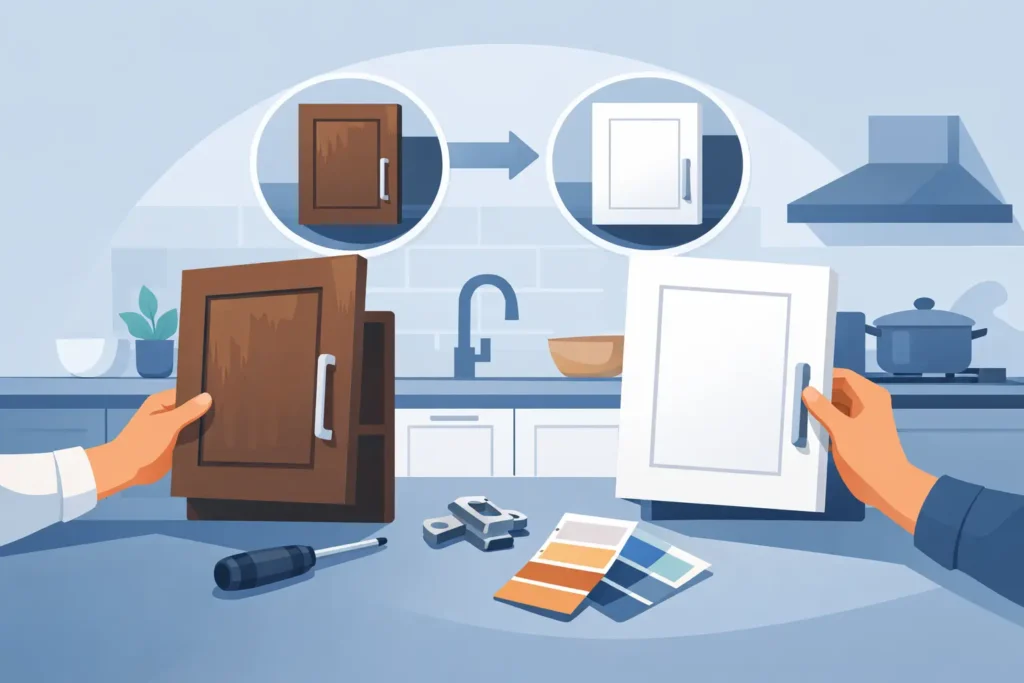
A kitchen can feel tired long before it stops working. Perhaps the cabinet doors no longer sit straight, the finish has dulled around the handles, or the colour belongs to a previous decade. Knowing when to replace kitchen doors helps you make a sensible investment: refreshing the room where the cabinet units are sound, while recognising when a more complete redesign will serve you better.
Replacement doors are not a shortcut in the negative sense. They can be an excellent way to give a well-built kitchen a new look, improve day-to-day use and avoid unnecessary disruption. The key is to look beyond the door fronts and assess the whole kitchen honestly.
7 signs it is time to replace kitchen doors
1. The finish is worn beyond a simple clean
Everyday kitchen life is hard on door surfaces. Steam, cooking residue, sunlight and repeated cleaning gradually affect painted, vinyl-wrapped and laminate doors. Small scuffs can often be touched in, but widespread peeling, swollen edges, deep scratches or discolouration around handles are different.
If damage is visible across several doors, replacing them is often more effective than carrying out a series of minor repairs. New doors can restore a consistent finish across the room and give you the chance to choose a material and colour suited to how your household uses the kitchen.
2. Doors no longer open, close or align properly
A door that catches, hangs unevenly or will not close cleanly is not always a reason to replace it. Hinges can work loose, and an experienced fitter can often adjust them. However, recurring alignment problems may point to warped doors, tired hinge holes or damage caused by moisture.
Check whether the problem affects one door or several. One troublesome hinge is a repair job. Multiple warped or sagging doors, particularly on heavily used cupboards, may make replacement the more lasting option. New doors fitted with quality hinges can make the kitchen feel noticeably more practical every day.
3. Your layout works, but the style no longer does
Many homeowners inherit a kitchen with perfectly serviceable cabinets but a style that does not suit their home. High-gloss finishes, decorative routed profiles or dated timber tones can make the whole room feel older than it is, even when the storage arrangement is useful.
This is where replacement kitchen doors make particular sense. Shaker doors can add warmth and character, while a contemporary slab door creates a cleaner, more streamlined appearance. Changing doors, drawer fronts, handles and end panels together produces a far more considered result than changing handles alone.
4. You are updating worktops, flooring or appliances
A new worktop can make tired door fronts more noticeable. Equally, investing in a new cooker, induction hob or integrated appliances can prompt a wider rethink of the kitchen’s appearance.
You do not have to replace everything at once. If cabinet carcasses are in good order, choosing new doors alongside a replacement worktop can create a substantial transformation with less waste and fewer building works than a full kitchen refit. It is worth planning the finishes together, however. Door colour, worktop pattern, splashback and flooring should complement each other rather than compete for attention.
5. The existing doors are difficult to keep looking clean
Some finishes show every fingerprint, while heavily detailed door styles can trap grease and dust around joints and grooves. This does not make them poor-quality doors, but it may make them a poor fit for a busy family kitchen or a household that prefers low-maintenance surfaces.
Replacing doors gives you an opportunity to match the design to your routine. A simple painted or matt finish, easy-clean profile and well-chosen handles can reduce the time spent maintaining the kitchen. In homes where children, pets and frequent cooking are part of normal life, that practical benefit matters as much as appearance.
6. You need better access to storage
Sometimes the door itself is only part of the issue. A corner cupboard that is awkward to reach, a bin cupboard that no longer meets your needs or drawers that are too shallow can make the kitchen frustrating to use.
Replacement doors can be combined with selected improvements inside the cabinets. You may be able to add pull-out storage, replace a damaged drawer front or alter a cabinet section without removing an otherwise sound kitchen. A home visit is useful here, as it reveals what can realistically be adapted within the existing layout.
7. You are preparing the property for sale or long-term living
A dated kitchen can influence how buyers feel about a property, but a full replacement is not always necessary before selling. Fresh doors and handles, particularly when paired with sound worktops and functioning appliances, can make the space feel cared for without overcapitalising.
For a home you intend to stay in, the calculation is different. It may be worth choosing made-to-measure doors and details that suit your exact room, including unusual cabinet sizes, angled units or a preferred paint colour. The better choice depends on your plans, the condition of the cabinets and the standard of finish you want to live with for years.
When replacement doors are not the right answer
Before ordering anything, inspect the cabinet carcasses. Look inside the sink unit, around the dishwasher and at the base of cabinets near external walls. Swollen chipboard, persistent damp, loose cabinet fixings and crumbling edges are signs that the underlying units may be nearing the end of their useful life.
A kitchen with serious water damage will not be improved simply by fitting attractive new fronts. The same applies where the layout causes daily problems, such as insufficient worktop space, poor lighting or appliances that no longer fit properly. In these cases, a more comprehensive kitchen redesign can be better value because it addresses the cause of the frustration rather than covering it.
It is also important to measure carefully. Standard replacement doors do not always suit older or bespoke cabinets, and even a few millimetres can affect gaps, hinge positions and how drawers open. A made-to-measure approach is particularly valuable where cabinets are non-standard, the room has uneven walls or you want a precise, fitted finish.
What to consider before choosing new doors
Start with the condition and dimensions of the existing kitchen, then consider the look you are trying to achieve. Take note of every door, drawer front, end panel and plinth. Replacing only the most visible doors can save money initially, but it can leave mismatched finishes if the original parts have faded.
Think about handles early rather than treating them as an afterthought. A handleless look needs accurate door and rail detailing, while bar handles need enough clearance from neighbouring drawers and appliances. The same is true of hinges: soft-close hinges and correctly drilled hinge positions are small details that have a large effect on the finished feel.
Colour deserves a practical conversation too. Deep blue, green and charcoal can look striking, but may be best balanced with lighter worktops or wall units in a smaller Dorset kitchen. Softer neutral shades are versatile and can make compact rooms feel calmer, while natural timber effects introduce warmth without needing a more traditional door style.
A considered refresh, fitted properly
Replacing doors is most successful when it is treated as a small kitchen project, not simply an online order. Accurate surveying, suitable materials and careful installation all affect whether the finished room looks intentional. At Hale & Murray, replacement doors and worktops can be made to suit existing kitchens, with practical guidance on what is worth retaining and what needs attention.
If your cabinets are structurally sound, new doors may be the change that makes you enjoy the kitchen again. If they are not, finding that out before you commit is equally valuable – it gives you a clear starting point for a kitchen that works properly for your home.