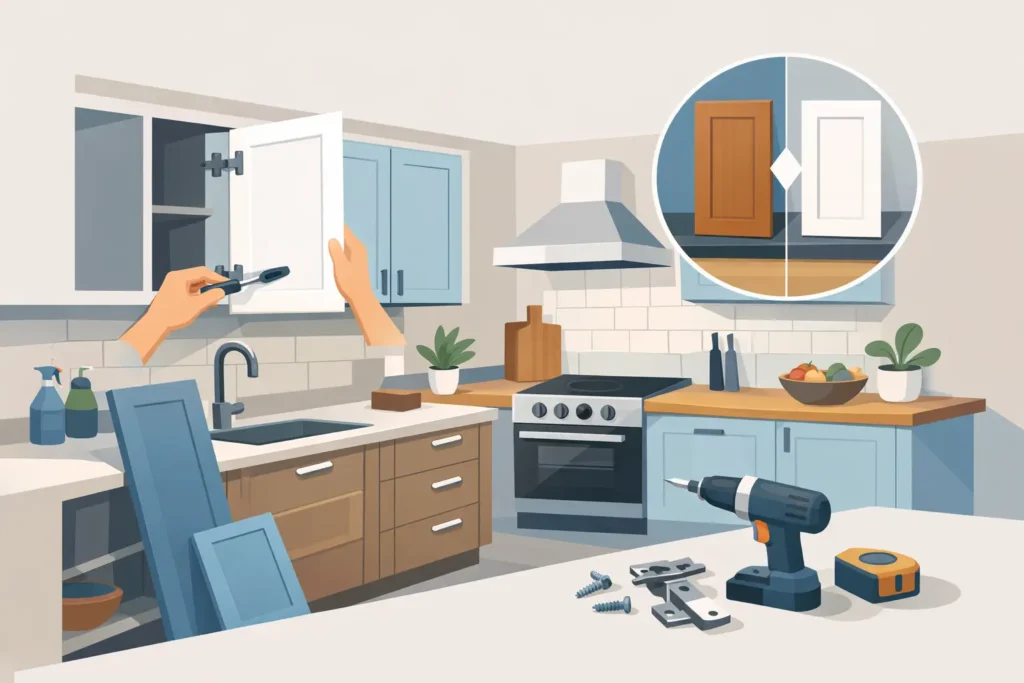
A kitchen can feel dated long before its cabinets have reached the end of their working life. If the units remain solid, level and practical, a guide to replacing kitchen doors can help you make a meaningful change without the cost, disruption and waste of a complete refit. New doors, drawer fronts and handles can alter the character of the room remarkably, but the best results depend on accurate measuring, compatible fittings and a considered choice of materials.
Replacing doors is not simply a matter of choosing a colour you like. Your existing cabinet carcasses set the rules for door sizes, hinge positions and overall alignment. Taking time to assess what can be retained is what separates a convincing kitchen refresh from one that looks like an awkward compromise.
Is replacing kitchen doors the right choice?
Door replacement works well when the cabinet boxes are structurally sound. Check that they are firmly fixed to the wall, free from swollen chipboard, and not damaged by leaks beneath the sink or around appliances. Open and close a few doors and drawers. If the units are square and the hinges can be adjusted, the foundations are usually there for a successful update.
It is also worth considering whether the kitchen still works for how you live. New fronts will improve appearance, but they will not create extra storage, move an inconvenient cooker or resolve a poor layout. If you need to reconfigure the room, add a peninsula, improve access or accommodate new appliances, a full redesign may offer better long-term value.
Worktops sit somewhere in between. A tired laminate surface can make even beautiful new doors look unfinished, while a sound worktop may be worth retaining. Replacing doors and worktops together is often a sensible middle ground, giving the kitchen a more complete transformation without removing every cabinet.
Guide to replacing kitchen doors: start with careful measuring
Most door-replacement problems begin with measurements taken too quickly. Do not assume that every door on a run of cabinets is identical. Older kitchens, in particular, may include small variations around end panels, integrated appliances, corner units and filler pieces.
Measure each existing door separately, recording height, width and thickness in millimetres. Measure the door itself rather than the opening behind it. Label every item on a simple sketch of the kitchen, including drawer fronts, fixed panels and appliance doors. Photographs are useful too, especially of hinges and unusual corner arrangements.
You will need to establish whether doors are full overlay, half overlay or inset. Most modern fitted kitchens use overlay doors, where the front sits over the cabinet edge. A full-overlay door covers most of the cabinet side, while two doors sharing a central panel may use half-overlay hinges. Inset doors sit within the cabinet frame and require particularly precise sizing.
Hinge-hole positions matter just as much as door dimensions. Standard concealed hinges commonly use a 35mm cup hole, but the distance from the edge of the door, the hole depth and the hinge plate arrangement can vary. Matching existing drilling is the easiest route. If replacement doors are made without hinge holes, they can be drilled to suit, but it is a job where a few millimetres make a visible difference.
Choose a door style that suits the room
A replacement door should suit the kitchen as a whole, not just the latest trend. A simple slab door can sharpen a compact contemporary kitchen and is easy to wipe clean. Shaker-style doors add detail and work well in both period homes and newer properties, although their framed construction gives dust and grease more edges to settle on. Handleless designs offer a clean look but may need careful planning around rails, profiles and opening comfort.
Finish has a practical role as well as a visual one. Matt surfaces are forgiving under softer light, but some darker matt finishes can show finger marks. Gloss reflects light and can help a smaller kitchen feel brighter, though it may show smudges more readily. Woodgrain and painted finishes introduce warmth and depth, particularly in larger open-plan spaces where the kitchen needs to sit comfortably alongside living furniture.
Think about the fixed elements that will remain. Floor tiles, splashbacks, wall colour and worktop tone should guide the choice. Bringing a sample home is worthwhile because showroom lighting rarely matches the light in a north-facing Bournemouth kitchen or a bright extension in Poole.
Do not overlook drawer fronts, panels and handles
Replacing only the main doors can leave a kitchen looking incomplete. Drawer fronts must be measured separately, and an integrated dishwasher or fridge door needs a compatible front with the correct fixing positions. End panels, plinths and cornices may also need updating if their existing finish clashes with the new doors.
Handles are a relatively small decision with a large effect. Long bar handles can make wide drawers feel balanced and easy to use, while knobs give a more traditional result. Consider the grip before committing, especially if children, older relatives or anyone with limited hand strength uses the kitchen regularly. Handleless doors can look refined, but make sure the chosen opening method is comfortable in everyday use.
For a cohesive finish, decide early whether you are retaining or replacing visible side panels and filler strips. A new door colour against an old cabinet end is one of the details that draws the eye for the wrong reason.
Fitting replacement doors with confidence
A competent DIY homeowner can fit straightforward replacement doors, provided the cabinets are in good condition and measurements are correct. You will need a drill and suitable bits, a screwdriver or driver, a tape measure, a spirit level and a way to protect the new fronts while you work. Avoid fitting on an uneven surface or leaning doors against a wall where they can be scratched.
Fit one door at a time, using the old door as a reference where possible. Attach the hinges, secure the door to the cabinet plates, then adjust the hinges gradually. Concealed hinges generally allow side-to-side, height and depth adjustment. Small changes are normal: the aim is consistent gaps, level lines and doors that neither catch nor spring open.
Start with upper cabinets or one clear run, then work methodically around the room. Drawer fronts are best aligned after the doors nearby are in place, so you can judge the visual gaps. Leave protective film on new doors until fitting is complete, but remove it promptly afterwards if the manufacturer advises this.
If you are replacing worktops, moving plumbing or fitting new integrated appliances at the same time, professional installation is usually the wiser option. These jobs involve several trades and sequencing them properly protects both the finish and the warranty on new materials.
When bespoke doors are worth considering
Off-the-shelf replacement doors can be suitable for common cabinet sizes. However, they are not always the best answer for kitchens with non-standard units, awkward alcoves, older cabinetry or a layout that has been altered over time. A bespoke approach allows doors, panels and drawer fronts to be made around the existing furniture rather than forcing the kitchen to fit a limited size range.
It also gives you more control over proportions and detailing. You may want a particular painted colour, a slim shaker frame, an unusual-height pantry door or matching furniture elsewhere in the room. These are the moments when local manufacture and an experienced survey make a tangible difference.
Hale & Murray can assess existing cabinetry, discuss replacement doors and worktops, and manufacture tailored components from its own workshop. For homeowners who want the reassurance of a managed service, professional measuring and fitting remove much of the uncertainty from a kitchen refresh.
Keep the refreshed kitchen looking good
Once installed, clean doors with a soft cloth, warm water and a mild detergent rather than abrasive creams or scouring pads. Wipe up water around sinks promptly and use the extractor when cooking to limit grease and moisture. Check hinge screws occasionally, particularly during the first few months, as normal use can reveal a small adjustment that improves alignment.
The value of replacing kitchen doors lies in keeping what still performs well and improving what you see and touch every day. A careful survey, well-made fronts and thoughtful fitting can give a familiar kitchen a more considered life for many years to come.